|
Past Reviews Off Broadway Reviews |
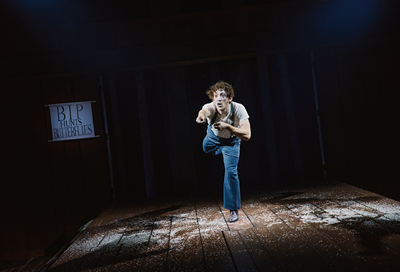
As Marcel (who was born Marcel Mangel in 1923 and died in 2007), Slater gives a masterful performance. His prowess as a physical comic, which he showed off to excellent advantage in the Broadway productions of SpongeBob SquarePants and the recent Spamalot, will not come as much of a surprise to audience members. He captures the balletic precision of Marceau's pantomime, and the exacting, elegant movement of his fingers, limbs, and torso defy basic corporeality. Butterflies undulate through his fingers, plants grow and wither from his arm, and invisible barriers press against his straining body. (Lorenzo Pisoni is the movement consultant.) In those moments, he is simply mesmerizing. What is more astounding (although not completely unexpected based on his fine performance of Boq in the Wicked films) are the ways in which Slater intermingles mischievousness and optimism with melancholy and despair. The play includes recreations of routines featuring Marceau's iconic character Bip, the hapless and eternally hopeful common person, who was inspired by Charlie Chaplin's Little Tramp. Like the great silent clowns before him, Slater encapsulates the joy, pain, and dogged determination of what it requires to be human. Marcel on the Train, which Pailet also directs, primarily examines a lesser-known aspect of Marceau's life. Before he became a renowned artist, Marceau worked for the French resistance. Between 1942 and 1945, working with his cousin Georges (portrayed in the play by Aaron Serotsky), he clandestinely escorted Jewish children from occupied France to safety across the Swiss border. In order to keep the children quiet and entertained, he drew upon his burgeoning mime skills. Reportedly, he saved almost 100 lives. Pailet and Slater's play focuses on one such trip in which Marcel, impersonating a boy scout leader, escorts four children on a train leaving from Limoge with hopes of arriving in Switzerland. The Jewish orphans, who are masquerading as boy scouts, include Berthe (Tedra Millan), a pessimistic girl with a bum kidney; Henri (Alex Wyse), a precocious and restless young man; the unflinchingly realistic Adolphe (Max Gordon Moore); and the traumatized and silent Etiennette (Maddie Corman). Marcel's attempts to distract his charges from the dangers outside of the train compartment in which they are sequestered call to mind Roberto Benigni's 1997 Life is Beautiful. That film is about a father shielding his son from the horrors and inhumanity of the Holocaust, but in Marcel on the Train, the displaced children (who are on the cusp of adolescence) have a clearer sense of the stakes involved. Their innocence has already been snatched away from them. Although there are instances of gripping suspense, particularly a scene in which a French Nazi tries to get the children to divulge their true identities, the tension is consistently undercut by the writing, the design, and to some extent, even the performances. The script contains numerous "memories," or flashbacks and flash-forwards, in which characters reflect on the events in the play. Breaks in the action with headings like "What Charles Remembers" provide contextual and biographical background. In this instance we learn about Marcel's father (Aaron Serotsky, who takes on multiple adult-character roles), a Jewish butcher who resolutely refuses to flee to Switzerland. Other remembrances provide insight into Marcel's storied career. In addition, the interludes are used to highlight the ways in which we are products of our memories, and we must be selective in determining how we want to memorialize our experiences. Marcel at one point instructs the children: "When we remember this time, and we will, all of us will remember this time, we'll have no end of ... wonderfully rotten memories to choose from. Of cruelty. Of indifference. Of one masked as the other. Wouldn't it be better if we chose a ridiculous memory instead?" The memory-induced reveries offer a chance to flesh out the characters, but we don't get to know the children well enough to be fully moved by their trajectories. And while the four actors are quite good, the sense of precarity is minimized when they are not represented as actual children. Scott Davis's scenic design transforms nearly the entire theatre into a train car, reminiscent of the bare, wooden carriages that transported Jews to the concentration camps. Hard, uncomfortable benches emerge from the floor, and Studio Luna's striking lighting and Jill BC Du Boff's dramatic sound design effectively gesture to the perils beyond the compartment. (Sarah Laux's costumes are notable in their ability to instantaneously shift period and context with minor adjustments.) Impressive as the design elements are, they do not contribute to the overriding feelings of claustrophobia the play should evoke. As a vehicle to put a spotlight on the life and deftness of a singular performer, Marcel on the Train is rather creaky. Yet Slater's performance and the chance to see an artist inhabit the artistry of another makes this a trip worth taking. Marcel on the Train Through March 22, 2026 Classic Stage Company Lynn F. Angelson Theater, Classic Stage Company, 136 E 13th Street Tickets online and current performance schedule: ClassicStage.org
|