|
Regional Reviews: Connecticut and the Berkshires Sweeney Todd: The Demon Barber of Fleet Street
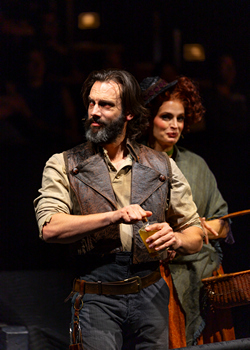
Sweeney Todd opened on Broadway in 1979, won the Tony for best musical and was staged in London the next year. It boasts Stephen Sondheim's music and lyrics and Hugh Wheeler's book, and is drawn from Christopher Bond's adaptation. Jonathan Tunick's orchestrations are of great import. The pacing is fast and the action is quite often furious. It seems, during the two hour and forty minutes of running time, that there must be upwards of twenty-five actors on stage, but in truth, nine dextrous, versatile performers carry on with a combination of vigor, charm, and skill. Scenic designer Luke Cantarella's multi-level, multi-purpose settings (mostly in gray and black) transport us back to 19th century London. Sweeney Todd (Matt Faucher) was imprisoned by Judge Turpin (Edward Watts) and his assistant Beadle Bamford (Brian Ray Norris). Turpin basically swiped Sweeney's wife and sent Sweeney away. But Anthony Hope (William Butler) brings Sweeney in from the sea. The whole company delivers a loud, rousing "The Ballad of Sweeney Todd" which tunefully explicates further. Todd's actual name is Benjamin Barker and when he goes to his old barbershop and discovers that, on a level just below, Mrs. Lovett (Jackie Burns) makes meat pies. Mrs. Lovett is eager to assist most vengeful Todd with his scheme since she reveals that Turpin was not only corrupt but far worse than that. Anthony (sweet-voiced Butler) falls hard for lovely, young Johanna (Lauren Maria Medina) who happens to be Todd's daughter. Butler's version of "Johanna" is a first act highlight as is the duet "Kiss Me," which features the young actors together. The subplot is sublime, the performance touching and believable. Sweeney (actor Faucher has a powerful, baritone voice) and Mrs. Lovett (Jackie Burns is always hyper-animated and on pitch) combine to deliver "A Little Priest" at the very end of Act 1. Sweeney has zealously killed those who have harassed and angered him, and Mrs. Lovett has a strong notion about what to do with the remains of those newly victimized. It's a fine ensemble cast and the lead performers have local ties. Matt Faucher attended the Hartt School at the University of Hartford while Jackie Burns received her B.A. in theatre at the University of Connecticut. Individually and together, they bring buoyancy and exuberance to the fore. The plot is intricate and those who catch everything while viewing for the first time are to be commended. That said, the Hartford Stage/TheaterWorks rendering captivates (pun intended) no matter what. Sondheim is at his musical best and so he liberally stretches conventional musical scales. This is alluring and/or atonal: take your pick. Listen for three offerings of "The Ballad of Sweeney Todd." Rob Ruggiero's zestful staging and interpretation of the show fuels the performance with expression and spice. The actors zip about whether they are on stage or, more than a handful of times, roam/trot up and down the aisles of the theater. Movement equals immediacy and involvement for everyone participating and many watching. Ruggiero inspires Todd to action rather than rage. When Sweeney slits someone's throat (and just before a dead individual is most creatively "dropped" below), lighting designer John Lasiter audaciously marks and bathes that moment with bright red color–again and again and again. A number of patrons know and appreciate Ruggiero for his deft storytelling direction, which distinguishes small cast shows at TheaterWorks. He has also helmed many larger musicals at The Muny in St. Louis as well as at Goodspeed Musicals in Connecticut. He and choreographer Ralph Perkins coax this dynamic cast to keep moving forward. To understate, it is no small task to pull together as robust a production of Sweeney Todd as the current one. Melia Bensussen, Hartford Stage artistic director, and Ruggiero worked together to facilitate this project. The presentation scores on all elements which fill the bill for musical accomplishment: feeling, plot and subplot, romance, exceptional lyrics and music, and even a bit of comedy, however wry. From time to time, the music is genuinely operatic. Sweeney Todd: The Demon Barber of Fleet Street, a co-production of Hartford Stage and TheaterWorks Hartford, runs through July 5, 2026, at Hartford Stage, 50 Church St., Hartford CT. For tickets and information, please call 860-527-5151 or visit HartfordStage.org or twhartford.org. |