|
Past Reviews Off Broadway Reviews |
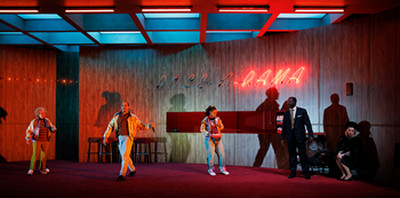
Set in Syracuse in December 1987, Reddick's play centers on a multigenerational Black family whose lives intersect with global politics on the eve of a nuclear treaty between the United States and the Soviet Union. At the center of the action is Meek, a precocious ten-year-old whose worries about imminent nuclear annihilation are filtered through children's peace choir rehearsals, Soviet pen-pal letters, and a mysteriously talkative Speak & Spell. Played by adult actor Alana Raquel Bowers in an E.T. shirt that evokes both that electronic toy and decal decade (costumes by Brenda Abbandandolo), Meek is drawn into a spy-like adventure when the Speak & Spell guides her toward a realm of espionage and international intrigue. While the play's premise is expansive and surreal, its strongest moments are grounded in more realistic family conflicts, especially the relationship between brothers Smooch (Will Cobbs) and Clay (Andy Lucien). Smooch, a former Black Panther who now runs the neighborhood roller rink, represents one vision of political engagement rooted firmly in community. Clay, by contrast, went to law school and renounces "power to the people" for what he calls "real power," working for the Reagan administration as a deputy national security advisor. These tensions explode in a series of confrontations that fuel the play with dramatic power. In a standout performance, Cobbs plays Smooch with volatile charisma, balancing swagger and wounded pride. Lucien's Clay carries the brittle confidence of someone navigating a political profession in which he knows he's still an outsider. Their constant clashes, particularly during a roller skating sequence that transforms comic choreography into a tragic physical showdown (movement by Baye & Asa), generate the production's most emotional and electric energy. Director Knud Adams (English) keeps the action fast-paced and fluid while Baye & Asa's stylized movement suggests roller skating without literal skates. A recurring red motif is threaded through Abbandandolo's costumes, Afsoon Pajoufar's scenery, Natalie Carney's props, and Masha Tsimring's lighting, signaling both Christmas and Cold War symbolism. Pajoufar's scenic design depends on curved walls clad in dark wood paneling that awkwardly attempt to mediate between the 1980s roller rink, the family's home, and other locales. At one end, a massive mirrored exit doubles and distorts the figures who pass through it, while at the other an elongated cut-out window serves as a skate-rental counter, an unsettling surveillance portal, and aperture through which the audience glimpses a private office during a pivotal high-stakes scene. The family's matriarch, Puddin (Lizan Mitchell), emerges as the play's sharp skeptic; Mitchell's dry observations land with charming wit and the authority of someone who has seen enough to know exactly how the world works ("Don't nothin' get past Puddin"). Virgie, Clay's quietly unraveling wife (Crystal Finn), serves as the catalyst for the estranged brothers' awkward reunion after a troubling encounter with a cult. A trio of singers (Suzzy Roche, Grace McLean, and Nina Ross, led by keyboardist/music director Ellen Winter) functions as a shape-shifting chorus, appearing alternately as children's choir members, Soviet agents, and uncanny narrators. Their harmonies are light, haunting, and hilarious, and Reddick's songs offer some structural glue to punctuate action or provide transitions. At times the show's many ideas (including Cold War espionage, childhood imagination, cult manipulation, class inequality, family estrangement, and the choral conceit) threaten to pull the plot in competing directions. Yet Reddick's writing retains a sense of play, allowing humor and absurdity to coexist with the darker implications of the story. The production's program notes include reflections by Lynn Rusten, former White House Director of Arms Control and Non-Proliferation, who quotes Mark Twain's observation that "History doesn't repeat itself, but it often rhymes." That line feels especially appropriate for describing Reddick's song-laden Cold War romp, written and staged at a moment when nuclear anxieties resonate. Ultimately, what lingers is not the geopolitical intrigue but the human scale of the conflicts. Cold War Choir Practice asks us to consider what it means to wield power in government, activism, or family life, and how those choices transmit across generations. For all the show's eccentric episodes, the arguments between Smooch and Clay feel recognizably real: two brothers raised under the same roof now standing on opposite sides of history. Cold War Choir Practice Through March 29, 2026 MCC Theater The Newman Mills Theater at the Robert W. Wilson MCC Theater Space Tickets online and current performance schedule: MCCTheater.org
|