|
Past Reviews Off Broadway Reviews |
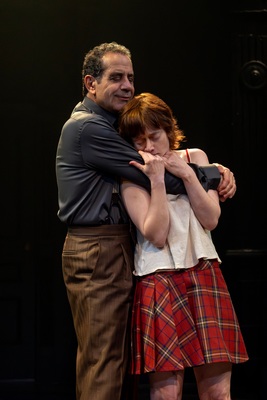
Under Tyne Rafaeli's tension-building direction, the terrific cast, which includes theatrical stalwarts Celia Keenan-Bolger and Tony Shalhoub, along with rising star Susannah Perkins who absolutely soars in the title role, are giving their gripping all for an audience that is seated three-quarters of the way around the intimate and unfussy performance space so that we are almost funneled into the action. At the start, Keenan-Bolger enters alone as a kind of one-woman chorus, which, in fact, is how she is identified. As the play progresses, however, she will not only comment on the action, but will instigate and ultimately become an active participant. (Now would also be a good time to note that the playwright happily toys with the concept of time and place throughout, yet does it so handily that you'll hardly notice the temporal distortion as then and now coalesce across common themes.) Our mono-chorus, occupying the here and now, begins by talking a bit about her various encounters with Sophocles' Antigone, a play she has never been able to enjoy or appreciate but which somehow keeps popping up in her life. One day, while she is on a plane circling over Pittsburgh, she has her eureka moment. It comes in the form of an encounter with a young woman who is reading and rapidly writing notes on a copy of Antigone. Piqued by curiosity, Chorus starts a conversation with the student, who explains her own frustration: "It's not like, is it even about her? It seems like it is all about her brother's body, a man's body." A sudden shockwave passes through Chorus, who finds a way to connect with the play for the first time, as a woman in her 40s, pregnant as it happens, and realizing that, like Antigone, her own voice has never been allowed to emerge. From here on, the play finds its purchase and purpose, and it never lets go. We join Chorus in traversing time, leading us, ultimately, to a place that has one foot in the contemporary world and the other in Sophocles' ancient Thebes. This go-round, the key players are Antigone and her uncle, Creon, newly anointed king after that horrific mess involving his sister Jocasta and her husband/son Oedipus. You remember them, right? If so, then remember, too, that Antigone is their daughter and has been psychologically battered by the revelation, her mother's suicide, and her father's self-blinding. Sophocles may have underplayed the consequences, but Anna Ziegler has not. The key setup pits Creon against his niece in hashing out the role of society when it comes to women's rights. Creon wants Antigone to conform to the body of rules and regulations he has put into place in an attempt to quell the near-collapse of Thebes' social order in the wake of Oedipus' downfall. Antigone argues that the purpose of the social order is to uphold the rights of its citizens. Antigone (This Play I Read In High School) is decidedly a feminist take on the source material, but it seldom feels insistent. Ziegler has striven mightily to let both sides of the argument sit out there for the audience to mull over. The main point of contention occasionally gets lost in the shuffle of multiple characters and plotting, but overall, the production, buoyed by powerful performances and a depiction of a heart-felt duel between a beloved if obstinate uncle and niece, is thoroughly compelling and gives us plenty to chew on as we make the connection between the mythological past and the current state of things. Antigone (This Play I Read In High School) Through April 5, 2026 Public Theater Barbaralee Theater (formerly Anspacher Theater), 425 Lafayette Street Tickets online and current performance schedule: PublicTheater.org
|