|
Past Reviews Off Broadway Reviews |
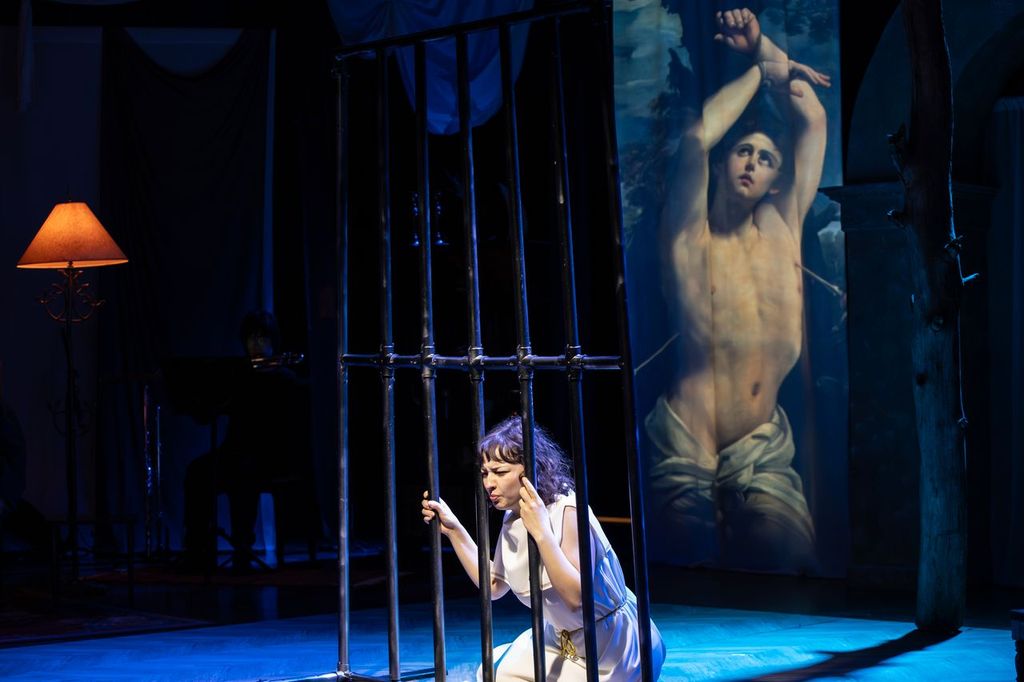
There seems to be a developing trend on the New York stages where audiences witness women characters deconstructing stage classics written by men, focusing on underdeveloped feminist aspects. The theme is currently being played out on Broadway in David West Read's book of the jukebox musical & Juliet, and was deeply dived into last season in Kimberly Belflower's John Proctor Is the Villain. A tragedy by the ancient Greek dramatist Sophocles is currently the subject of two explorations through feminist eyes. At The Public, there's Anna Ziegler's Antigone (This Play I Read In High School), and now at La MaMa, via the New York Innovative Theatre and Obie Award-honored Peculiar Works Project, comes Barbara Barclay's smart and evocative Antigone in Analysis. In several ways, the is exactly the kind of theatre people have been coming to La MaMa for since the 1960s: a little off-beat, intellectually niche, and highly worthy of post-theatre discussion. Director Ralph Lewis' production captivates upon entry, with set and projection designer Evan Frank welcoming audience members with an elegantly furbished parlor containing the curious feature of a dead tree prominently propped up. Both sides display paintings by the likes of Joan Miró, Wassily Kandinsky, and Paul Klee, suggesting the controlled chaos of the abstract discussion to come. Onstage flutist Samantha Kochis performs composer Alana Asha Amram's soothing music as, one by one, projections announce the arrival of an ensemble of authors and analysts who will serve as the play's Greek chorus. There's French psychoanalyst Jacques Lacan (Sammy Rivas), dressed by costume designer Grace Martin as though he's starring in a Noël Coward drawing room comedy. Non-binary gender studies author Judith Butler (Linnea Scott) appears in a baggy suit and sneakers. Feminist philosopher Luce Irigaray (Nomi Tichman) wears comfy bohemian garb, while theologian Søren Kierkegaard (Simon Henriques) and philosopher Georg Hegel (Mick Hilgers) sport period 19th century attire. The subject of their lively discourse is the title character Antigone, who was born out of the incestuous relationship between Oedipus and his mother Jocasta. As Sophocles dramatized, Antigone faced a death sentence for trying to provide a proper burial for her brother Polynices, deemed a traitor by her uncle, Creon, ruler of Thebes. "Antigone is not just against authoritarian law. She's against a blatantly patriarchal law," insists Butler. So as a matter of experiment, the five imagine how the story might be different (or exactly the same) if it were her mother's law that she broke. Enter Bianca Leigh playing Jocasta, now ruler of Thebes, and Alessandra Lopez as her rebellious daughter Antigone. The two play out the conflicts of the Greek tragedy while the scholars from later centuries, when they're not doubling as supporting characters, dig into their psyches. Lacan, for example, ponders if Antigone's actions are motivated by romantic love for her brother. "Is Antigone carrying forward the trauma of incest? Like mother, like daughter?" Indeed, in her program notes, Barclay explains how exploring her relationship with her mother was the initial inspiration for the play ("Especially, her blindness to who I was."), and her work delves into considerations of a daughter's obligation to her mother and if children have a right to expect unconditional love from their parents. But the theme that dominates the proceedings is a debate on the existence of gender-based behavior, in this case how it may pertain to a woman leader empowering a system that some may call intrinsically patriarchal. In her portrayal of Jocasta, Leigh arrogantly postures and pronounces in a way reminiscent of several tyrannical males who may come to mind. Butler notes, "Even though physically, she is a woman, she rules like a man so she presents as masculine." When Antigone, played with sensitive nobility by Lopez, insists that Jocasta doesn't need to deny her maternal nature in order to rule, the queen counters, "I should show compassion? Softness? Timidity? Weakness? Why would I need that to rule? Oedipus did not need any of that." Whether intentional or not, the way Jocasta and Antigone are cast brings to mind the contemporary visual of conservative blonde women in the forefront of a movement rejecting contemporary feminism and being challenged by a liberal side demanding social justice which is more likely to include BIPOC women. Toward the play's end, in a moment symbolic of the imprisoned Antigone's suffering, a winged creature appears to sing in what the author describes as "an ethereal, otherworldly voice". That prerequisite is thrillingly achieved by soprano Freja Højland Høj. As the two chorus members who, in real life, are still alive, ponder the future, Irigaray optimistically notes how women today have more power to stand up to sexist laws without having to die for their principles. "But some still do, you know," observes Butler. Antigone in Analysis Through April 5, 2026 La MaMa's Downstairs Theatre 66 East 4th Street Tickets online and current performance schedule: LaMama.org
|