|
Past Reviews Off Broadway Reviews |
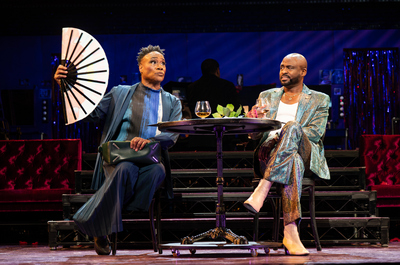
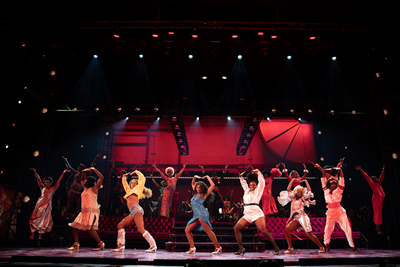
Long-time Encores! fans may sigh at the reappearance of a musical that has been anything but ignored or lost to time. La Cage aux Folles, with a book by Harvey Fierstein and music and lyrics by Jerry Herman, opened on Broadway in 1983, in the midst of a musical theatre era that was well into a Sondheimian shift toward sophistication along with a plethora of Lloyd Webbery concept shows. And yet here it was, this unapologetically old-fashioned musical that managed to draw in audiences for four years, had two Broadway revivals since then, and picked up 11 Tony Awards along the way. That's more than either Sweeney Todd or Cats has garnered to date. Encores! has always focused on celebrating original musical scores. And there is much to celebrate in Jerry Herman's score for La Cage aux Folles, from the chanson-inspired "Song on the Sand," to the celebratory "Best of Times," to the defiant anthem of pride that ends Act I: "I Am What I Am." The Encores! Orchestra, here under the baton of guest conductor Joseph Joubert, is sounding spiffy as always. But if that's not enough reason for you, then consider the show to be Encores! salute to Pride Month, a reminder that, at a time when anti-LGBTQ+ activism is once again soaring, there is more to June 2026 than "Go Knicks" and the FIFA World Cup. This production of La Cage aux Folles has been directed by Robert O'Hara, who is generally thought of as someone who likes to push the boundaries (Slave Play is a notable example). Here the boundaries have been pushed in a direction that would seem to be suggested by a lyric from "The Best of Times," namely the line that asks, "What's left of summer but a faded rose?" There is an intentional faded shabbiness to David Zinn's set design, a back-of-the-closet look to Clint Ramos and Michelle Ridley's costumes, and an often purposefully slovenly set of performances by Les Cagelles, who sometimes look as though they are trying out for one of the stripper roles in a road company of Gypsy. There's also a world-weariness to the two-decade relationship between the show's central characters, the steady Georges (Wayne Brady) and the emotionally volatile Albin (Billy Porter).
One problem with La Cage aux Folles in general is its shifting tone, which veers from genuinely sincere and heartfelt and even defiant in Act I to move ever closer in Act II to being swept up in the French farce of the same title on which the musical is based. To that end, you've got Jacob (James Jackson Jr.), the flamboyantly over-the-top butler/housemaid, and all the business surrounding the domestic plot that dominates Act II. If you don't recall, it's all about a meet-the-folks gathering between the central gay couple and the future in-laws of Georges' son Jean-Michel (Alaman Diadhiou, a terrific dancer if less so as a singer). The villain of the piece is Edouard Dindon (Peter Francis James; his character's surname is French for "turkey"), a virulent anti-gay politician and an altogether loathsome person. Dindon's nose is bent out of shape from the moment we meet him until he gets his comeuppance. It's all designed to lead us to an upbeat ending, which it does. But, still, there's a lot of pain (from Dindon's ugliness to Jean-Michel's hurtful treatment of Albin) that gets swept under the rug. I can't say that an all-Black cast places La Cage aux Folles in a new light, and I wonder at some of the rough-hewn performances, though these are certainly in keeping with Robert O'Hara's directorial style. Still, I wouldn't hesitate to recommend this production, which has a heart big enough to embrace us all. As an aside, it was especially nice to see Harvey Fierstein in the audience a couple of rows in front of me. No fuss was made about his being there, but it is his unmistakable voice you will hear making the usual pre-recorded opening announcements regarding phones and photos and ending with a welcome call: "Happy Pride to everyone!" La Cage aux Folles Tickets on sale through June 28, 2026 City Center Encores! 131 W 55th St (between Sixth and Seventh avenues) Tickets online and current performance schedule: www.nycitycenter.org/
|