|
Regional Reviews: Chicago Hamnet Also see Christine's review of Miss Julie
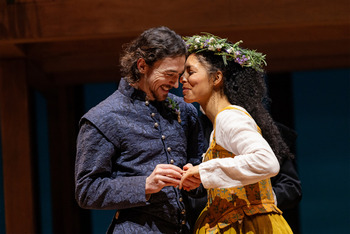
In an interview with Pippa Hill, the show's dramaturg, both O'Farrell and Chakrabarti discuss unearthing Agnes, who is all but unknown from documentary evidence, from the sterling wives and otherworldly women of Shakespeare's plays. In discussing how she approached adapting a novel for the stage that is not organized chronologically, Chakrabarti responded, "Theatre stages are huge machines of set and cast and you don't want to stop the flow of the story for a scene change or a jump in logic," further stating that she'd found the answer to this conundrum in the realization that Agnes is the story's main character. Given these articulations of Chakrabarti's intentions, it seems curious that the play comprises a series of scenes that are rather short and do not show particular concern for emotional throughlines. If there is an analogy to Shakespeare's work, the pacing feels like one of the histories, which cut quickly from one part of the battlefield to the next without lingering too long on any particular arc. Moreover, Agnes never quite feels like a real person. Her wild-girl-of-the-forest persona charms William in an echo of every manic pixie dream girl of the last two decades of film. When she gives birth to her first child, Susanna, there is the intriguing suggestion that Agnes might embody women's knowledge of health and healing, particularly as it relates to childbearing and family medicine. The idea is rife with potential and the blend between dreamlike staging and practical, feminine interaction during the births of Judith, then the twins, indicates that Chakrabarti is interested in it, but ultimately, it is imperfectly realized, at best. When Agnes's second pregnancy unexpectedly results in her delivering twins, Judith's presumed physical weakness comes across as a plot device. It dims the joy of the birth of a son, prevents Agnes from joining William in London, and becomes the first focus of Agnes's guilt and grief when Hamnet dies. But she abruptly shifts blame to William, who arrives too late and leaves all too soon to return to the business of his own career and supporting the family. All of this is more than believable, but the play's structure does little to support these manifestations of joy and grief as any kind of evolution. There is much interest between the lines, including different modes of grief shaped by gender and class, economic realities in tension with emotional expectations, and so on. But while purporting to focus on Agnes, Chakrabarti's text rarely follows through on these intriguing threads with Agnes or any of the other characters. For example, Susanna seems primed to (rightly) resent the fact that she is neglected for the sins of being neither the son nor the frail, unexpected child, but by the end of the play, she is simply the cheerful, dutiful daughter. We see glimpses of William's grief and the way it damages his personal and professional relationships, but this seems to have little impact on Agnes and her world. The staging does fill in some of the gaps that seem inherent in text itself. Tom Piper's set, is a functional, visually interesting whole; it also shifts and evolves in a way that translates much more readily than the text of the play. Agnes and William's "annex" is cozy, if confining. The ladders that grant entrance to this lofted space, which Judith and Hamnet share later in the play, are attached to ropes so they can either lean inward to create an A-frame or ascend to the top of the more expansive spaces of the house William moves the family to as he prospers (Piper is also credited with the costume design, which also succeeds in tracing this upward trajectory), and ultimately to the Globe. The transformation into the theater, to which Agnes ultimately makes her way to confront her absent husband, is particularly spectacular. Prema Mehta's lighting is also quite beautiful. It captures the romance of the forest as easily and effectively and the intense psychological impact of the Globe as Agnes witnesses the manifestation of Will's grief and achieves something of a catharsis of her own in watching Hamlet interact with the ghost of his father. It is also plays an integral role in supporting some of the stylized movement (Ayse Tashkiran, movement director), particularly early in the play, that lends Agnes and the setting their otherworldly qualities. Mehta's lighting is also important in establishing the fact that this is, ultimately, a ghost story. Simon Baker's sound design also provides support for this, creating ghostly whispers, the conversations that echo back and forth in time, and the haunting, percussive exhale that recurs throughout the play. However, the music, composed by Oguz Kaplangi, is not always tonally in sync with these efforts, as it leans heavily into what sounds like hand drums that often seem to be competing with the strings, rather than working with them. Overall, this contributes to the issues with the show's choppiness, rather than further supporting the lighting and sound design, which tend to smooth over the abrupt transitions. As Agnes and William, Kemi-Bo Jacobs and Rory Alexander certainly have chemistry as the young lovers, and to the credit of both, where the play does offer opportunities to give the characters life as real people, both rise to the occasion. The struggles that lead William to leave Stratford to try to scrape out a living for his family feel real and heartwrenching, and their moment of emotional reconnection at the play's end is electrifying, showcasing what Jacobs, in particular, is capable of. Ajani Cabey and Saffron Dey are engaging as the twins, Hamnet and Judith. The play calls on them to run the gamut from ethereal versions of themselves who exist largely in Agnes's mind to the flesh-and-blood children that occupy her existence in the latter half of the play. Cabey and Dey do good work cultivating both the slightly unreal twin relationship and establishing the two as real-world individuals. Dey has only a few brief moments to convey the weight that Judith carries as the twin who survived, but makes the most of them. For Cabey's part, his performance as Hamlet, opposite Rory Alexander as the ghost, is easily the deepest, most effective moment of the play. Ava Hinds Jones is a stalwart, stabilizing Susanna. Her performance is strong enough that one wishes that Chakrabarti had been more interested in how the character grows in the shadow of her siblings and father's fame as well as how the thread of her grief is woven into the family's emotional fabric. In Agnes's birth family, both Troy Alexander as her brother Bartholomew and Nicki Hobday as her angry, brittle stepmother, Joan, have interesting potential as characters, and the actors make the audience wish for more depth and opportunity here. Troy Alexander's dry humor and sturdy, no-nonsense evaluation of his sister's life and choices serve as a reminder of the tensions between life in Stratford and London. Hobday is deliciously cutting and oppressively judgmental as Joan. The performance does much to counteract the fact that the play renders rather two-dimensional and treats her as a plot device. Matilda McCarthy also fits into Agnes's family as her supportive friend Jude. The role is an interesting one that has more depth than most of the other supporting characters. McCarthy laudably makes the most of this and breathes life into yet another manifestation of Shakespeare's women, the nurse and confidant whose support is essential to the girls and and other women in his plays. William's birth family is also somewhat broadly drawn, but the actors are largely successful in adding nuance. Heather Foster as his sister Eliza and Penny Layden as his mother Mary support the mission voiced by O'Farrell and Chakrabarti to imagine what might have been the real-life inspirations for Shakespeare's women. As William's volatile, violent father, John, Nigel Barrett is not quite as successful in fleshing out the sketch that the play provides for the character. Fortunately, though, Barrett is double-cast as Will Kempe. Despite the character's association with Shakespeare's larger than life comedic roles, it's here that Barrett injects depth and pathos. In this endeavor, Barrett collaborates effectively with Bert Seymour, who brings life to Richard Burbage, despite quite minimal material. Hamnet runs through March 8, 2026, in the Yard at Chicago Shakespeare, 800 E. Grand Ave., Navy Pier, Chicago IL. For tickets and information, please visit www.chicagoshakes.com. |