|
Regional Reviews: Chicago The Brief Wondrous Life of Oscar Wao Also see Samantha's review of Charlie and the Chocolate Factory, Kelly's reviews of Admissions and Dear Evan Hansen and Kyle's review of Black Cypress Bayou
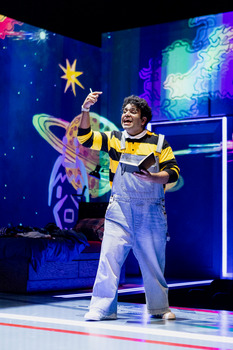
Díaz's title character is the son of Beli, a single mother whose emigration from the Dominican Republic to New Jersey was fueled by her experiences of personal, structural, and political violence. Although Beli's determination has won opportunities for Oscar and his sister Lola, including the ability to attend Rutgers on full scholarships, racism, deeply entrenched colonial thinking, and colorism continue to follow the second generation and constrain both their individual sense of self and what it means to be Dominican in the United States. Whereas Lola's explorations lead her into activism and, in particular, an embrace of her African roots, as an aspiring writer, Oscar has largely retreated into an interior world shaped by graphic novels, anime, and high fantasy. This manifests in not just social awkwardness and flowery, overly formal speech, but in a fixation on fukú, a supposed family curse to which he attributes not just his mother's cancer, but his own struggles with mental health, which have already led to long-term psychiatric care in the wake of heartbreak that stemmed from the disconnect between reality and his own worldview. This pattern repeats in both acts, as Oscar fixates first on Jenni, a goth girl whose own history of trauma leads her to lean on Oscar (and seemingly mislead him about the nature of their relationship), and then on Ybón, a prostitute he falls for on first sight when he, Lola, and his roommate Yunior travel to the Dominican Republic. Through Oscar, Díaz offers insights into the intergenerational conflicts in immigrant families, as well as the possibilities and constraints inherent in different cultural and generational views of love and gender. However, the play's nearly exclusive focus on Oscar comes with troubling subtext. In particular, the play risks romanticizing mental health issues (and/or conflating mental illness with neurodivergence, and thus potentially fetishizing the latter). Moreover, there is so little attention ultimately paid to the play's women that it risks retelling a very stale story, indeed–one that holds young women like Jenni responsible for safeguarding the hearts, minds, and well-being of young men, and turns (presumably) older women like Ybón into props through which young men seek self-actualization. All of this said, the story succeeds as a fairy tale or fantasy, and it is to the credit of both the source material (both the novel and the original production by Repertorio Español) that one wants more of Lola, Yunior, and Beli, secondary characters that come to life despite the play's narrow focus. The set design by Regina Garcia and in particular the projections designed by Stefania Bulbarella provide a strong foundation for the fantasy mindset. The L-shaped stage is set at an angle to the audience backed by a proscenium that evokes the frames of comic book panels. The liberal use of bold neon lighting (design by Max Grano De Oro) pushes the visual metaphor even further, although it is worth noting that the visuals are more successful in Act I than Act II, where there are some awkward compromises between fantasy action and the practical needs of set changes. These are exacerbated, but the choice to mirror Oscar's costume (denim overalls and a brightly striped polo shirt) in the stage crew amplifies some of these distractions. The sound design by Willow James, however, helps to smooth over some of these bumps, in addition to successfully bridging the two-dimensional nature of the graphic novel metaphors and Oscar's enthusiasm for anime and, more importantly, his desire to bring his fantasies to bear on the real world. Raquel Adorno's costumes are especially well done. In particular, Adorno focuses on the women of the play, which adds important dimension to Lola and Beli and nuance to the fact that the same actor portrays Jenni, Ybón, and the "Trujillo Woman" who oversees the violence that ultimately drives Beli from the DR to the US. Lenin Izquierdo is an engaging and sympathetic Oscar. The text calls on him to handle the character's poetic, overblown dialogue with enough subtlety to render other characters' reactions to it believable from moment to moment, and Izquierdo is more than up to the task. The moments when Oscar's interior world ruptures and devolves into mental health crises are somewhat rushed, but the strength and subtlety of Izquierdo's performance help to remedy this. Julissa Calderon is similarly skilled in handling the character of Lola, particularly given that the play gives the actor less to work with, and there is some built-in risk that things might slip into a "sassy/angry woman of color" stereotype. There's no danger of this with Calderon, who successfully plays more than seems to exist on the page, not just in terms of Lola's relationship with Oscar, but importantly with Yunior and Beli as well. As Yunior, Kelvin Grullon has tremendous appeal that makes the audience wish that we got to know more about him, his flaws, and his own ambitions as a writer. Grullon's performance is particularly strong in the wake of Oscar's attempted suicide at the end of Act I, when we see Yunior struggle with both the genuine care he has for his friend and for Lola and the fact that his own life of loss and confused identity has left him unprepared to meet the moment. As Beli, Yohanna Florentino's careful performance in Act I lays the groundwork for what we see of young Beli in Act II. Early on, Florentino treads close to the line of a stereotypical immigrant mother who rides herd on her children to ensure they do not squander hard-won opportunities. This makes her portrayal of the vibrant, loving young Beli in Act II all the more powerful and ultimately heartbreaking. As La Inca, the adoptive mother/grandmother of Beli and her children, Rossmery Almonte has similar issues to confront. When we first meet La Inca, she leans into the abuela stereotype and plays the laughs that the text demands. Almonte's performance blossoms, though, as she acts as the narrator for the stylized retelling of young Beli's heart-wrenching story. Jalbelly Guzmán (Jenni/Ybón/Trujillo Woman) and Arik Vega (Dionisio/Manny/Capitan/Goon) have unique challenges to confront, as they are called upon to depict the story's "others." The multiple casting for each tells its own story, to a certain extent. Dionisio (young Beli's problematic lover), Manny (Jenni's problematic boyfriend), and the Capitan (Ybón's corrupt, violent lover) are archetypes, and as such they must be played similarly. Vega's stylized, highly physical performance in each role fits in well with the "mission statement" to take the entire play as a fantasy. Guzmán has more difficult material to grapple with. She does well for the most part, distinguishing Jenni, the very Jersey Gothic Lolita, from Ybón, the Dulcinea to Oscar's Don Quixote. Her performance as the Trujillo Woman showcases her range as an actor, but ultimately there is only so much one can do with the stereotypes baked into the material, complete with some quite awkward dialogue and accusations against these characters that the text leaves unanswered. The Brief Wondrous Life of Oscar Wao has been extended through April 12, 2026, at Goodman Theatre, Owen Theatre, 170 N. Dearborn, Chicago IL. For tickets and information, please visit GoodmanTheatre.org or call 312-443-3800. |