|
Regional Reviews: Chicago The Cuttlefish: Or, The Hyrcanian Worldview Also see Karen's review of The Drowsy Chaperone
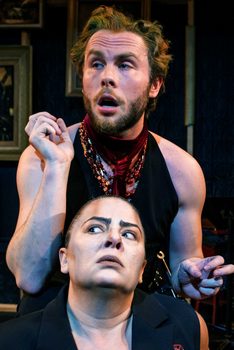
Trap Door Theatre immediately places the audience into the world of Witkiewicz's surrealist undertaking. If you have not yet encountered the intimacy of their Bucktown theatre, it is important to note that the eclectic nature of their space seems almost purpose-built for this show. Upon entering the theater, audiences immediately encounter the show's eccentric characters. Checking reservations, serving drinks, and exploring the movement of their bodies in the space of the theater, the ensemble paints the atmosphere with intrigue before the proverbial curtain rises. The scenic design (Merje Veski) mirrors the mélange of characters trafficking through it. The walls are covered in paintings that have been burned, and the stage is peppered with low-flung, classical pedestals. Several of the characters move through a series of silhouettes and postures, seemingly taking up space for no other reason than to assert their presence without apology. The costumes (designed by Rachel Sypniewski) are themselves unique works of art, projecting the archetypal aspects of each character but layered with abstractions that complicate our initial assumptions. Emerging from his silent existence in the pre-show, the artist, Pawel Rockoffer (Nicole Wiesner), cries out to a God he does not believe in to exclaim the absurdity of his existence and the futility of his artistic efforts when all is met with ridicule and destruction. Rockoffer seeks escape from a world unaware of its own psychosis, which is manufactured by an insistence on pragmatism. Wiesner proves perfection in her role as our guide through the wild inner workings of her character. Her ability to pull action out of esoteric dialogue draws us further into the wacky absurdities we encounter. This comes to bear right away as Rockoffer first turns his attention to his former spouse, the Statue of Alice d'Or (Keith Surney), nostalgically recounting the influence of her beauty and questioning Alice about whether his current fiancée, Ella (Gus Thomas), can inspire him enough to find his way out of his existential crisis. Enter the Pope. Rockoffer acknowledges that he remains a devout Catholic despite his disbelief in God. But Pope Julius II (Emily Lotspeich) is unconcerned with the contradiction, explaining that his excursion from Heaven is precipitated by his own search for artistic beauty in spite of authority. Lotspeich is eminently watchable as the Pope. Her dynamism swings between wielding the sacred assuredness of her authority and an insatiable appetite for sucking all the marrow from the bone of life on this side of eternity. With the philosophical underpinnings of the play firmly established, Ella enters to assert her position as the recipient of Rockoffer's affections and to paint her own picture of the blissful domestic life that awaits them. Uninspired, Rockoffer seems put off by Ella's advances and her need for reassurance but reluctantly confirms his desire to marry her. Alice and Pope Julius share their misgivings about Ella and the betrothed couple, worrying that Rockoffer will sink further into a societal prison devoid of life's creative expressiveness. Ella pushes back against these characterizations–and Thomas effectively activates our empathy for Ella–but she is eventually interrupted by the entrance of the extravagant King Hyrcan IV (David Lovejoy). Hyrcan puts the conflict of the play into immediate perspective. Ella represents for Rockoffer the embodiment of an authoritarian pragmatism imposed upon society by forces which share no love for the messiness of artistic endeavor. His promotion of the Hyrcanian worldview, however, celebrates the hedonistic exploration of desire–an allusion to the distant historical land of Hyrcania as an exotic and wondrous place unpoliced by rigid social norms. Lovejoy infuses his performance with a boundless energy that electrifies the space, bringing a madness to King Hyrcan that expertly walks the line between chaotic and quixotic. The surrealist absurdisms of the play, the loose threads of the plot, and the wild energy realized by the performers make The Cuttlefish: Or, The Hyrcanian Worldview a night of theatre like few others. And the show is as timely as it is entertaining. Witkiewicz wrestled with the ontology of art and the place of the artist in society amidst a growing authoritarianism in pre-war Europe. With the current administration's cuts to arts funding, the creep of ever-more draconian censorship, and the perilous existence of living as an artist in our country today, the questions posed by the play ring like alarm bells. In particular is pragmatism's role as the antagonistic force in the play, making for a critique of capitalism's devaluation of the arts in society; where art that cannot be transmuted into a monetizable craft or fetishized as a symbol of elite wealth makes for nothing more than superfluous rubbish. The Cuttlefish: Or, The Hyrcanian Worldview challenges such assertions, reminding us that to create, to perform, to express is to exist–and existence needs no justification. The Cuttlefish: Or, The Hyrcanian Worldview runs through April 25, 2026, at Trap Door Theatre, 1655 W Cortland St, Chicago IL. Performances are on Thursdays, Fridays, and Saturdays at 8pm, and Sundays, April 12th and April 19th at 3pm. For tickets and information, please visit our.show/the-cuttlefish or call 773-384-0494. |