|
Regional Reviews: Chicago The Three Musketeers Also see Karen's review of Modern Gentleman
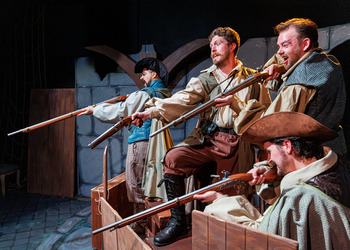
It's greatly to the credit of the adaptation that, although the show runs more than two hours, it never drags. The Idle Muse production similarly deserves credit for delivering on the expected swashbuckling, with a large cast, in the confines of a black-box theater. The formula for this success rests on the across-the-board capability of the production team and the smart allocation of resources. Jeremiah Barr's scenic design is physically minimal, yet makes an impact with the deliberately broken stone and beams set flush against the walls, as well as a painted floor that serves as both the cobblestones of Paris and the hay-covered stable floors further out from court. In the few instances where a more involved set is called for, the production answers with hilarious suggestions of horses and bastions. The lighting design by Laura J. Wiley augments the physical set, casting the shadows of arched stained glass windows as well as dingy grates that allow only the barest glimpse of light into various dungeons. The costumes by Vicki Jablonski flesh out the scenic design, efficiently communicating through color, cut, and opulence who is allied with whom and allowing ensemble members to shift seamlessly between various characters without ever confusing the story. L. J. Luthringer's sound design and composition also make contributions that are integral to the production by stitching scenes together and driving the action forward with interstitial music. The work of violence directors Libby Beyreis (also credited as assistant director) and Brendan Hutt is also certainly important, as no adaptation of Dumas succeeds without scheduled duels and chance encounters that devolve into physical altercations. Beyreis and Hutt have done impressive work in supporting the cast to work safely in close confines without sacrificing the adventuresome spirit of the show. On a related note, Mario Mazzetti's work in dialect and voice direction supports the production's commitment to the politics of the story by distinguishing the French, English, and Spanish characters from one another. But overall, the highest recommendation for the production is how unfailingly fun its performances are. Troy Schaeflein is a sincere heartthrob of a D'Artagnan. His performance combines full awareness of what's funny in the text with a guileless commitment to each and every bit, but there's nothing of the fool who winks to the audience in his portrayal. He is fully and appealingly the romantic hero who has earned his cape, his appropriately ridiculous hat, and ultimately his new rank by the play's end. Jack Sharkey (Athos), Boomer Lusink (Porthos), and Xavier Lagunas (Aramis) are hard to separate as the titular musketeers, as their work together is excellent, and yet their performances certainly deserve individual distinction. Lusink's take on Porthos honors the outsized personality and appetites of the character from the novel, but he finds opportunities to convey both charm and wit, rather than leaning into a lunkhead stereotype. Lagunas brings an intensity to Aramis that deepens the character, rather than playing either his piety or his affinity for romance as a joke. Sharkey, for his part, is not afraid to explore all the ways in which Athos is something of a hot mess without compromising the fact that Athos, foremost among the three, is who D'Artagnan admires; Sharkey is rightly confident that his performance keeps the character sympathetic and admirable. In the early going, Jennifer Mohr's Milady is somewhat backgrounded, and there's a danger that the character will simply become an exaggerated villain lurking in the shadows. However, Mohr builds the character throughout and takes her beyond just the femme fatale whose wickedness binds the men more tightly together. The adaptation, direction, and Mohr's performance come together to create a believable political stance for the character that pays off in the second act. Joel Thompson (Rochefort) and Eric Duhon (Richelieu) have similar issues to contend with. Rochefort, in particular, has little dialogue, though the character is often on stage, and Thompson manages to convey intensity and an inner life that drives him. Duhon, in contrast, leans into the villainy. His Richelieu is pompous and arrogant, yet the performance is memorable and unique. The production double casts Benjamin Jouras as both Louis XIII and Buckingham, and Jouras is up to the challenge of playing Louis as a ludicrous fool early on, then turning on a dime to demonstrate how dangerous a volatile fool can be when those around him feed into his insecurities about his wife. His Buckingham, in contrast, is appropriately suave and superficially earnest. Jouras plays the obsession with Queen Anne straight, letting the violence of the war that Buckingham more or less single-handedly starts speak to the dangers of mixing obsession and politics. Caty Gordon's performance as Queen Anne elevates this facet of the story. Gordon's queen is level-headed and aware of the precarious position she and France are in, yet she is clearly passionate and drawn to Buckingham despite her better judgement. One of the interesting decisions the production (or perhaps the adaptation) makes is to split the character of Constance into two, D'Artagnan's landlady (Bonacieux) and her sister (Constance). The interest here is amplified by the fact that Vanessa Copeland, who plays Bonacieux, is double cast as Jane (rather than John) Felton, the Puritan who is set to guard Milady. This offers the play's women even more opportunities to enter into the machinations within the court and the politics of the play itself. Jamie Redwood (Constance) and Copeland face off over Bonacieux's decision to climb the social ladder by throwing her allegiance in with Richelieu and Milady, whereas Constance sides with love and loyalty. This also offers Redwood and Schaeflein a chance to build a more interesting romance than is possible if D'Artagnan is simply romancing his landlord's wife. In a similar vein, the fact that Copeland, as Felton, is seduced by Milady's feigned religious persecution adds interesting layers and remedies at least some of the source material's almost exclusively male focus. Idle Muse Theatre Company's The Three Musketeers runs through April 25, 2026, at The Edge Off-Broadway Theater, 1133 W Catalpa Ave., Chicago IL. For tickets and information, please visit IdleMuse.org or call 773-340-9438. |