|
Regional Reviews: Chicago Catch as Catch Can Also see Christine's review of Untitled Vampire Play, Kelly's review of Damn Yankees and Karen's review of Brokeback Mountain
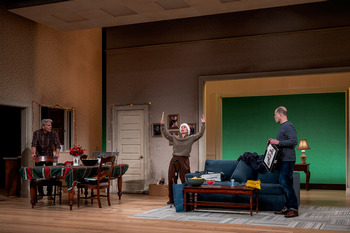
The story unfolds over the course of several months, primarily in the New England home of Roberta and Lonnie Lavecchia. As the play opens, Roberta and the widowed Theresa sip tea and mull over deep questions, such as how Princess Diana would have felt about Kate and Meghan. From the first moment their conversation turns personal, a dark, uneasy current begins to stir. Even as two women engage in stereotypical complaints about adult children who refuse to recognize that mother knows best, Chung weaves in a thread of bigotry. But the exchanges are so rapid-fire that these shocking asides land before the surrounding laughs have faded. In retrospect, this forces contemplation of the brand of mainstream, "pre-PC" comedy that we, as audience members, passively consumed. The convention of each actor playing a woman and a man, as well as a member of the elder and younger generations, builds on this productive discomfort by forcing examination of the things we're still primed to laugh at, either as unproblematic "truths" about men and women, or remnants of an outdated mindset that will surely die off on its own. The madcap tone reaches its climax as Roberta struggles to keep her preparations for a massive family Christmas dinner on track, even as the impending celebration grows and the needs of guests grow ever more complex. It's at this point that Chung's tone shifts sharply toward the dark and dramatic as Tim, Theresa's son who has only recently returned from California, ostensibly to get his mother's help laying the groundwork for his wedding, begins to mentally unravel. The text unravels with him. Rather than the visual comedy of actors exiting as one character and re-entering as another, the shifts in person are increasingly swift and ultimately devolve into long stretches of broken dialogue, often delivered to unseen people, that tell the fragmented story of Tim's mental deterioration and the toll it takes on the tightly knit world around him. Although there's a case to be made that the intentions of the play's latter half are murkier and somewhat less effective than those of the first, as a whole, the work clearly merits the superlatives that have been applied to it since its world premiere, and this production offers worthy support for it. Andrew Boyce's scenic design, supported by Yuki Nakase Link's lighting and sound design by Mikhail Fiksel, is subtle and effective. On the surface, the set is simply a realistic rendering of middle-class home, but the use of nested, progressively narrowing prosceniums and not-quite-private spaces facilitates the necessarily brisk blocking and contributes to the claustrophobic atmosphere. The ease with which the living room transforms into Tim's room in a psychiatric ward mirrors the uneasy blend of humor and bigotry and underscores the way Roberta and Theresa, in particular, are invested in curating and sanitizing their own images and those of their families, even with those they are theoretically closest with. Izumi Inaba's costume design wisely takes a minimalist approach. Inaba uses accessories like glasses on a chain, a wrist-worn pin cushion, and a handbag to signal when the male actors are playing female characters. Other than a gaudy Christmas apron that Roberta dons at the climax of the play's first half, there's nothing in the costuming that is exaggerated or played strictly for laughs. The same is largely true for both the direction and the performances. Gary Cole (Roberta and Robbie Lavecchia), Tim Hopper (Theresa and Tim Phelan), and Audrey Francis (Lon and Daniela Lavecchia) do certainly lean into the stereotypes of the older generation and their prejudices. But the touch they take in terms of gender (it's in this generation that each actor plays a character whose gender differs from their own) is comparatively light. As the three younger adults, their performances are more naturalistic and less mannered. Hopper has the strongest and most fully realized characters to play and his performance more than repays Chung's investment in both Theresa and Tim. Hopper strikes a remarkably effective balance with Tim, in particular, as he earns the audience's sympathy while not shying away from the fact that his damage plays out in gendered ways inclined to continue the generational cycle. Gary Cole is the anchoring comedic force of the cast. His fine-tuned performance allows Theresa heightened melodramatic moments that feel true to a character, rather than veering into a drag performance. The character of Robbie is, perhaps, the least fleshed out in the play, but Cole injects humanity here, as well, particularly in the final moments when the play is at its most conventional. Like Cole, Audrey Francis strikes the right balance between comedic stereotype and lived-in character as Lon. As Daniela, Francis takes a patient approach. She allows the character to get a bit lost in her first scene with Tim and Robbie, only offering the occasional pushback as the two men seek to use their version of her to assert their own characters. But as Tim tries to hang his own survival (or failure to survive) on the role Daniela will or will not agree to play in his life, Francis lets the character come into her own as she strives to do the right thing by Tim without submitting to her own destruction. Catch as Catch Can runs through July 12, 2026, at Steppenwolf's Downstairs Theater, 1650 N. Halsted, Chicago IL. For tickets and information, please visit steppenwolf.org or call 312-335-1650. |