|
Regional Reviews: Connecticut and the Berkshires Driving Miss Daisy Also see Fred's review of John & Jen
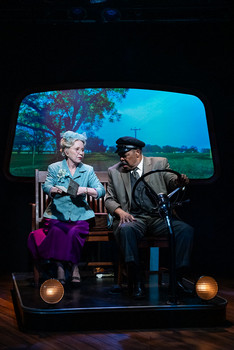
Reflecting upon his own grandmother, Uhry composed the three-person play and it began Off-Broadway in 1987. Taking place in Atlanta, Georgia between 1948 and 1973, the script includes snappy opening moments as Daisy Werthan (Rupp) contests her son Boolie's assertion that she, at the age of 72, can no longer operate a motor vehicle. It seems Daisy has just wrecked the car and Boolie (Matthew W. Korinko), the dutiful son, will get her a driver. The energetic, acerbic Daisy doesn't like the idea. The beginning sequence of the show quickly catches the audience's attention. Bert Scott's scenic design perfectly enhances the action. Scott has fashioned three settings which allow the actors maximum interface with the audience. The overall look is favorably symmetrical. On one side is an old couch and lamp of the period; and on the other a wooden desk. A "car," with a steering wheel and a couple of headlights, is situated on a slightly elevated platform, occupying center stage. The driver sits in a wooden chair and the passenger on a wooden bench behind him. The overall design includes windows behind each of the three components, which lighting designer David Lander and projection designer Tim Brown utilize to change sky color and, in one case, show images of Martin Luther King Jr. Early on, Hoke Colburn (Ray Anthony Thomas) answers questions Boolie poses. Hoke is hired and immediately becomes Daisy's driver. The seventy-two-year-old Daisy is Jewish, and Hoke, perhaps 10 or 12 years younger, is African-American. Daisy is greatly vexed that Boolie has gone ahead with his plan since she feels quite capable. Advocating privacy, she would rather be by herself. However, she is stuck with her plight and time moves along. Daisy Werthan, a Southern woman, is initially distrustful of Hoke Colburn, but she becomes far less biased as the play evolves. Hoke takes her, multiple times, to the cemetery. He drives across the state line to Alabama when she wants to see her brother. Uhry, through the course of his plot, prompts bonding: Daisy and Hoke, as the years go by, realize they have each another. Eventually, Daisy's mind and body fail her, and Boolie has no other choice but to place his mother in a nursing home. When Hoke visits her, Daisy, for these moments, becomes lucid and concerned about Hoke's health. He is probably 80 or more at this point and, with terrible eyesight, no longer drives. Debra Jo Rupp, performing with understanding, never rushes with Daisy. Her movements are quicker during opening sections of the play but never frenetic. Ray Anthony Thomas's deep-rooted, effective acting is a fine match. He is sensitive and penetrating. His facial expression reveals his feelings. Uhry's third character, Boolie, is far more than a mediator. Boolie has heartfelt affection for his mother and must make difficult, even distasteful decisions. Matthew W. Korinko, a skillful actor, is convincing. Director Julianne Boyd gives her three seasoned actors space to create through disciplined performance. This warm, moving play follows through with an essential socio-political theme. Uhry, from Atlanta, writes with authenticity; Hoke and Daisy represent different cultures and both have lived through telling civil rights years. The dialogue is personal and rings true throughout this 85-minute production, one which advises that people, even those who appear to be oppositional, might become closest of friends. Driving Miss Daisy runs through June 21, 2026, at Barrington Stage Company, 36 Linden St., Pittsfield MA. It then moves to the '62 Center in Williamstown from June 26 - July 5, 2026. For tickets and information, please or visit barringtonstageco.org call 413-242-6411. |