|
Regional Reviews: Minneapolis/St. Paul In the Green Also see Renee's review of Les Misérables and Arty's review of Men on Boats
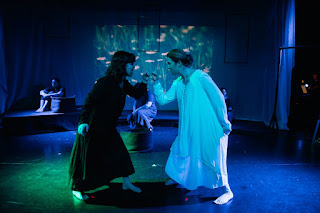
In the Green is about Hildegard von Bingen, who lived in 12th century Germany and was canonized by Pope Benedict XVI in 2012. Hildegard was a multi-faceted woman who was well ahead of her time, with accomplishments as a religious writer, philosopher, mystic, medical writer and practitioner, preacher, and a composer whose soaring melodies go beyond the constraints of traditional Gregorian chants of her era. Her achievements are the more remarkable when one learns that she spent thirty years of her life, from the age of eight to the age of thirty-eight, confined in a cell lacking natural light, within a Benedictine monastery. Hildegard and her compositions garnered attention in recent decades, part of efforts to reveal the historic role and contributions of women, and to expand upon women's roles in the modern church. She was certainly not a typical woman of the church at her time, for in her life work she broke many boundaries, such as being granted permission by church leaders to write down her visions and to preach at church gatherings, rights previously granted only to men. However, In the Green doesn't venture into the boundary-breaking work of her later life–she lived to be eighty-one–but focuses on her time in that darkened cell. The show begins in the year 1106 as Hildegard's parents tithe her as an oblate, meant to live a life dedicated to Christ and God (and relieve them of the burden or her care). She shared that cell with Jutta von Sponheim, who acted as Hildegard's guide both in matters of the spirit and survival. Actually, in the guise of In the Green, the two are closely intertwined. Jutta is an anchoress, meaning a woman physically sealed off from the world as if already dead in order to devote her thoughts to the life beyond. She subsists on meager portions of food and water delivered through a window. Though records suggest that Jutta was only eight years older than Hildegard, In the Green depicts her from the start as a commanding woman. The density of lyrics and complexity of rhythms in her songs bear testimony to her authority. In creating this one-act musical, McLean had the ingenious notion of portraying Hildegarde's brokenness with three actors each playing one element of her sensory experiences in the outside world. The three are Eye, who has seen too much; Mouth, who has said too much and hungered too much; and Hand, whose sin has been to gather too much. Eye, Mouth, and Hand often speak and sing independently of one another, though at times their voices (sung or spoken) join in unison, while at other times they respond back and forth to each other. Jutta promises Hildegard that her brokenness will heal through asceticism, patience, and hard labor–labor represented as constant digging into the earth beneath their cell. When, after struggling with this for some time, Hildegard's broken parts feel little progress and despair of becoming whole, Jutta tells them that she too was broken and followed this same course to make herself whole. She will not, however, reveal the cause of her break. Eventually, Eye, Mouth, and Hand dig deep enough to find another being, called Shadow–the buried shadow of the pain that had broken Jutta. Through Shadow's confessions, Eye, Mouth, and Hand learn Jutta's story and realize that Jutta made herself whole by burying her past, not by knitting it together. This spurs Shadow, Eye, and Mouth to work through the trauma that led to their brokenness and finally become whole once more. After Jutta's death in 1136, the cell opened, allowing Hildegarde to experience light and air. Hildegard is now a thirty-eight-year-old woman, at this point portrayed by Abilene Olson as a unitary person. The cell door is opened to bring in a new oblate, who will be placed under Hildegard's tutelage. However, Hildegard refuses to mentor the child in a darkened cell, and insists that she go on guiding the child in the light of the world. Hildegard becomes engaged in many branches of church-related work, and begins to amass a following. McLean's score contains gorgeous music that uses recurring themes, wending themselves into complex madrigal-like melodies as well as modern theatre songs that hinge between soulful and mournful, with a quality that brings to mind Michael John La Chiusa's Marie Christine and Jeanine Tesori's Violet. McLean's songs for Jutta are more forceful, closer to a blues-rock vein. She makes frequent uses of loop recordings that capture snippets of her voice, repeating those in a loop so that Jutta sings accompanied by iterations of herself, creating a sense of her as a large and omnipresent force in contrast to Hildegard's withdrawn brokenness. The play has a great deal more singing than spoken text. Much of the dialogue is colloquial and contemporary, as when the Marchioness calms the fears of Hildegard's mother about confining her to a cell by saying "Inside the cell, she'll be technically dead, but super comfortable." That easygoing way with dialogue makes it more accessible and guides the audience to consider that this 900-year-old story has something to say to us, and especially to women, today. As always at Theatre Elision, the caliber of both vocal and instrumental music is exquisite. This production would be worth going to even if one kept eyes closed and merely listened. Christine Wade is an outstanding vocal director, as evidenced by the results, and also sings–and acts, but especially sings–with a raging force as Jutta. Deidre Cochrane as Mouth, Abilene Olson as Hand, and Annie Schiferl as Eye all sing beautifully, whether solo or in harmony, and express the pain and eventual redemption Hildegard goes through. Emily Hensley gives an equally strong performance, vocally and dramatically, as Shadow. Music director Harrison Wade and fellow musicians Jeff A. Miller (bass) and Miles Whealy (drums) perform the well-orchestrated score. Director and designer of the costumes and set Lindsay Fitzgerald has created a feel for the environment of Hildegard's world using extremely simple elements as she steers the story seamlessly on its journey. As In the Green nears its end, we understand (though details are scant) that Hildegard emerges as a leader of a sect within her Catholic universe. Years pass and she is confronted by a young woman, the sole survivor of another sect that was persecuted by followers of Hildegard, who viewed them as a threat. This young woman demands to know: "Who was it you were helping?" We are faced with the paradox repeated countless times over history, that those who gain ascendancy over their oppressors through good works and intentions run the risk of becoming unyielding, and oppressors of any who bring forth different idea. This point, though trenchant, feels hastily made after the pains taken to evocatively present Hildegard's process of healing and self-discovery. Perhaps a second act dealing with her life from the time she leaves her cell and enters the light through this endpoint would offer a fuller sense of both her struggle to be whole, the enormous gifts she brought forth, and the contradictions that may have trailed her later in life. In the Green was written and composed by Grace McLean as a commission by Lincoln Center. It premiered at Lincoln Center's Off-Broadway Claire Tow Theatre in 2019. In the Green, a Theatre Elision production, runs through March 7, 2026, at the Elision Playhouse, 6105 42nd Avenue North, Crystal MN. For tickets and information, please visit www.elisionproductions.com. Book, Music and Lyrics: Grace McLean; Director, Set and Costume Design: Lindsay Fitzgerald; Music Director and Pianist: Harrison Wade; Vocal Director: Christine Wade; Movement Coordinator: Madeline Wal; Sound Engineer: Lilly Paul; Lighting Design and Stage Manager: Laina Grendle. Cast: Deidre Cochran (Mouth), Emily Hensley (Shadow), Lux Mortenson (understudy), Abilene Olson (Hand), Annie Schiferl (Eye), Christine Wade (Jutta). |