|
Regional Reviews: Minneapolis/St. Paul Joe Turner's Come and Gone
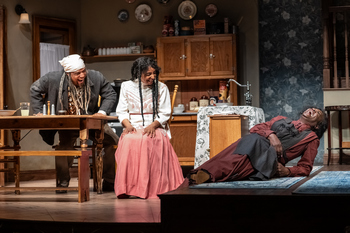
Penumbra's company knows their way around Wilson's terrain. Nearly twenty-one years after his death, Wilson remains listed as a member of Penumbra's company (Penumbra honors its root by maintaining the names of all who have been part of their company on its roster, noting those who have passed from this life). Wilson wrote five of his ten Century Cycle plays during his twelve years (1978-1990) in St. Paul. The current production marks the twenty-first Penumbra staging of one of those ten plays, having done all of them at least once, and Fences, Two Trains Running, Jitney, and now Joe Turner's Come and Gone three times. Moreover, this production is directed by Lou Bellamy, founder and artistic director emeritus of Penumbra, who was there all through Wilson's presence, making the two frequent collaborators and friends. Bellamy has directed all ten of Wilson's Century Cycle plays, acquiring a sixth sense for the meanings embedded in Wilson's intricate narratives and the poetry he assembled from the most common, vernacular language. Each of the plays is set in a different decade of the twentieth century, and all but Ma Rainey's Black Bottom are set in the Hill District of Pittsburgh, the African America neighborhood where Wilson grew up. Over the course of the century, Wilson depicts, on an altogether human scale, the shifts in the internal workings of Black communities and their place in relation to the broader fabric of American life. Joe Turner's Come and Gone is set in the century's second decade, specifically, 1911. Forty-six years after the thirteenth amendment formally abolished slavery, freed slaves and their descendants continued to search for families torn asunder by "the peculiar institution" and its aftermath, struggling to stake an economic foothold and to overcome the ways, both subtle and overt, that genuine freedom remained an illusive vision. The "Great Migration" saw waves of Black Americans leave the south for perceived better opportunities and equality in the industrial north. The play is set in a boarding house, an apt setting to epitomize the coming and going of people searching for one another, for roots in a community, and for themselves. The boarding house is a respectable establishment run by Seth and Bertha Holly. Bertha is constantly seen working–cooking, washing, laundering, and all the labor of running the house. Seth works nights at a mill, and by day works in a shop behind the house crafting pots and pans out of sheet metal. He sells these to a white travelling salesman, Selig, the only white character in the play. Selig is also what is called a "people finder"–a man who people pay to find other people who have disappeared from their lives, whether by their own volition or forced separation. When the play opens, the house has two boarders. Bynum is an old soul who remembers his days picking cotton in the South and uses totems and incantations to, as he puts it, bind people together who ought to be bound together. Bynum has been at the house several years, and seems to have made it his home. The other boarder is Jeremy, a callow, womanizing young man working on a road construction gang by day and playing guitar in local joints by night. A sad-eyed young woman named Mattie shows up looking for Selig. She wants to hire him to find Jack, her man who has left her without a trace. Selig won't be back from the road till Saturday and smooth-talking Jeremy persuades Mattie to stay with him, at least till Selig finds Jack. Another woman, Molly, arrives to rent a room in Pittsburgh because she missed her train to Cincinnati. Molly is a worldly woman, beholden to no man. The two women, Mattie and Molly, make for quite a contrast. The play pivots on the arrival of Herold Loomis and his eleven-year-old daughter Zonia. Loomis is shrouded in mystery and misery. A wide brimmed hat covers his eyes and an oversized coat absorbs his body. He is looking for his wife, Martha, who he's not seen for eleven years. For the first seven of those years Loomis was trapped in a Tennessee work camp, doing what amounted to slave labor. When he regained his freedom, Loomis went to find is wife and the daughter he had never known. He found Zonia being raised by her grandmother. The two have been wandering, looking for Martha Loomis, ever since. Despite misgivings about Loomis' menacing countenance, Seth rents him a room, urged to do so by Bertha, who feels for the plight of the sweet young girl. Wilson's narrative draws out the pain and uncertainty inflicted by generations of trauma, as well as the inner and communal resources that enable those afflicted to keep moving forward. The answers are as varied as the individuals seeking them. Part of the answers are found through the readiness to seize an opportunity when it shows up, part through reaching back to ancestors, part through trying to divine the future. It is rife with heartache and humanity, and against all odds, unquenchable hope. The actors in this cast are magnificent. James Craven is perfect as crusty Seth Holly–Craven played Herold Loomis in a prior Penumbra production of Joe Turner. Seth is grounded in the present tense, focused on keeping himself, his wife, and the life they have built going through with no room for sentiment. What could be more utilitarian than the forging of pot and pans? Tonia Jackson is perfectly matched to him as Bertha, her warmth and generosity providing the balance to Craven's bluster. Their rapport together presents the authenticity of a long-lasting partnership buoyed by affection and a graceful acceptance and understanding of one another. La'Tevin Alexander is mesmerizing as Herold Loomis, establishing Loomis' foreboding façade, then shockingly revealing the chaos within when Bynum draws out the searing pain Loomis has buried, triggered by singing the song that gives the play its title. Alexander causes us to both fear and pity the deeply wounded Loomis. Lester Purry is fantastic as sagacious Bynum, surviving with one foot in the practical realities of this world and the other in a dimension of spirit and memory. As Jeremey, Darrick Mosley totally delivers the short-sighted nature of a young man without moorings, to easily lured from one shiny proposition to another, and getting through life with a flashy smile. Vinecia Coleman reveals Mattie's wounded heart and absence of a sense of self-worth; she is someone everyone feels compelled to offer advice to but who finds the possibility of her own salvation in soothing another's wounded heart. Dana Lee Thompson's Molly conveys the crust of a tough-talking gal whose studied slow gait seems meant to announce her refusal to hurry on anyone's account, though in the end, she submits to an opportunity, one of dubious promise at that, that undermines her professions of strength. Terry Hempleman has the congenial, albeit mercenary, Selig down cold–he has played the role at Penumbra before and manages to make Selig likeable even as he blithely talks about his great grandfather who captained a slave ship across the ocean from Africa. Nubia Monks makes a late but powerful appearance as Martha Pentecost, conveying a hailstorm of emotions in her lone scene. At the performance I attended, Zonia was played by a delightful Juliah Jefferson, a poised and expressive twelve-year-old actor. Camren Graham–another impressive 12-year-old actor–played Reuben, the neighbor boy who befriends Zonia, bringing out her normal adolescent interests in spite of the untethered life she has lived. Vicki Smith designed a beautiful interior setting, showing the boarding house's kitchen on one side and the parlor on the other, with a zig-zagging staircase going upstairs, as if to say there are not straight paths leading upward. A sliver of yard provides green space in front of the house. Matthew LeFebvre's period costumes are apt reflections of each character's position and beautifully rendered, abetted by Jamaka Webb's wig designs. Donn Darnutzer's lighting design and Sean Healey's sound design skillfully embellish the production. A spirited celebratory Juba dance is choreographed with elan by Marciano Silva Dos Santos. Penumbra's current production of this modern classic marks a welcome return of one of the greatest voices ever to rise in American theatre. Let us hope it won't be ten years before the company mounts another of August Wilson's masterful plays on its stage. Anyone who values brilliant playwrighting, top-flight acting, stunning stagecraft, or stories that reveal the teaming life and boundless hope beneath the scabs of America's self-inflicted wounds must see Joe Turner's Come and Gone. Joe Turner's Come and Gone runs through June 21, 2026, at Penumbra Theatre, 270 North Kent Street, Saint Paul MN. For tickets and information, please call 651-224-3180 or visit www.penumbratheatre.org. Playwright: August Wilson; Director: Lou Bellamy; Set Designer: Vicki Smith; Assistant Set Designer: Michaela Lochen; Costume Designer: Matthew LeFebvre; Assistant Costume Designer: Jocelyn Reed; Sound Designer: Sean Healey; Portland Playhouse Sound Designer: Rory Breshears; Lighting Designer: Don Darnutzer; Props Designer: Jenny Moeller; Wigs and Makeup Designer: Jamakah Webb; Juba Dance Choreography: Marciano Silva Dos Santos; Intimacy Coordinator: Kaja Dunn; Production Manager: Dylan Nicole Martin; Stage Manager: Ajah Williams; Assistant Stage Manager: Constance Brevell. Cast: La'Tevin Alexander (Herald Loomis), Mathias Brinda * (Zonia Loomis), Vinecia Coleman (Mattie Campbell), James Craven (Seth Holly), Zayd Felix * (Reuben Mercer), Camren Graham * (Reuben Mercer), Terry Hempleman (Rutherford Selig), Tonia Jackson (Bertha Holly), Juliah Jefferson *(Zonia Loomis), Nubia Monks (Martha Pentecost), Darrick Mosley (Jeremy Furlow), Lester Purry (Bynum Walker), Dana Lee Thompson (Molly Cunningham). *alternate performances |