|
Regional Reviews: San Francisco/North Bay Our Class
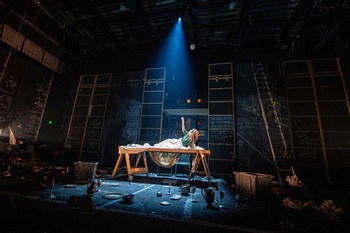
Despite the depressing tale, which is based on a tragic, real-life occurrence in the village of Jedwabne, Poland, Our Class is a thrilling theatrical journey into a moment in history which was not revealed to the wider world until our current century. I will spare you the horrific details of the pogrom and focus instead on the simple yet powerful stagecraft and performances used by Arlekin and Z Space to tell the story. As the audience assembles in the cavernous ambience of Z Space's Steindler Stage, the cast mill about on the stage, hugging and greeting each other like old classmates at a school reunion. Soon, ten chairs are placed in an arc, and each of the performers occupies one of the seats. They begin by introducing themselves–Zygmunt, Jakub, Abram, Dora, Zocha and others–and state their hopeful future occupations: wagon driver, fireman, cobbler, movie star, etc. In these first moments, it feels like the performers aren't quite off book yet, for each refers to their binders as they deliver their early lines. Soon enough, though, the binders are set aside and the characters begin to interact with each other as students in a classroom. It won't take long before the tensions between the Catholic children and the Jewish children come to the fore. There's a moment when one of the Jewish kids gets a bicycle and the Catholic bullies take it from him, sparking their nascent anti-Semitism–which will become much, much worse as the play goes on. You will watch as Abram (Richard Topol) happily informs his schoolmates that he is off to America, where he will become a rabbi and attempt to keep in touch with his old friends via a series of letters, which are indicated by use of a handheld video camera, the signal from which is projected on the upstage blackboard wall. This wall, and a few simple props–sawhorses, a four by eight sheet of wood, ladders, balls and balloons, a large crucifix, plus projections (by Eric Dunlap and Igor Golyak)–create all the spaces these actors need to represent the many scenes in the village. Naif chalk drawings float across the board, and characters use chalk to communicate the symbology and subtext of the onstage action. At one point, a hammer and sickle are crudely drawn, only to be erased and replaced by a swastika, as the Soviet influence gives way to Nazism. Abram at one point writes "Thou shall not kill" multiple times, and at another writes "Leviticus 18:19," a verse that contains the phrase "love thy neighbor as thyself" but also limits the definition of "neighbor" as being "your people." Just how broad the definition of "your people" will be depends very much on the mood of the moment. For the Jews of this village, the Catholics very much did not believe in them as neighbors. The performances by this troupe of actors sort of sneak up on you. At first it's all casual, flipping through their binders like this is a first read-through. But as the narrative progresses, each performer goes deeper and deeper into their character, so that when a man is beaten or a woman savagely raped, it comes like a punch in the gut; you may sense it coming, yet it still hits with surprising power. When Rachelka, who changes her name to Marianna (played by Chulpan Khamatova) after converting to Catholicism, is in the later stages of her life, she is bundled in scarves and sweaters, an old woman who can no longer afford to be cold. This cast, some of whom were imported from a run at BAM in New York in 2024 (before transferring to Classic Stage Company), have had enough time with the text to take it deeply into their bones–which makes the conceit of starting out as a first reading a little hard to accept. Even harder to accept is the level of cruelty and lack of compassion the Catholic poles showed to their fellow villagers. Our Class can be hard to watch, yet brilliant to behold. Our Class runs through April 5, 2026, at Z Space, 450 Florida Street, San Francisco CA. Performances are Tuesday-Saturday at 7:30pm, with matinees Saturday and Sunday at 1:30pm. Tickets range from $67 to $147. For tickets and information, please visit www.zspace.org. |