|
Regional Reviews: San Jose/Silicon Valley Palo Alto Players Also see Eddie's reviews of We Will Rock You and The Toxic Avenger
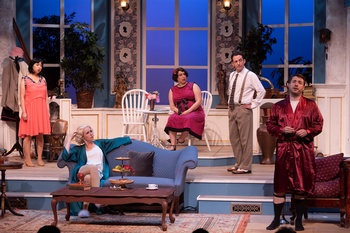
In scanty lingerie and an exposing robe, respectively, Sylvia and Beau are about to dress and depart his mother's cottage after their once-a-year (for the seventh year) night of bedtime frolics–but only after a few more kisses. That they are both married and that they are sister-and-brother-in-law is of no matter to them because, after all, as Beau reminds Sylvia, "This is not romance; this is sex." But Sylvia has other ideas of what "this" is now and what "this" could be in the future and has sent, unbeknownst to Beau, not one but two telegrams that will set off a maelstrom of shocks and surprises. Infidelity is just the first of a host of delightfully delicious secrets and sins that Rustin has hidden in the corners and crevices of this lovely little cottage. Knocks on the front door become the impetus for uproars of audience laughter as each one brings another enticing entanglement to the mixture of present and past relationships that are, for the most part, totally unknown to the others who are arriving one by one–all of course unexpectedly. As the bombshells multiply in hilarious explosions all the way through to the final minute of the fast-paced two hours (with intermission), believe it or not, some of the biggest laughs come from cigarettes and lighters, with a line like, "I love it when you smoke; you look so healthy," a bonus after a "ciggie" has once again popped up from the most unlikely location. To tell much more of what actually happens would kill the fun of the blindsides each character has coming from seemingly nowhere, the revelations that lead to sudden shifts in love and alliance, and to flabbergasting lies that have been perpetrated for years whose truths suddenly spill in gushes, creating messes that cannot easily be mopped up–even as these socialites take time among all the chaos to compliment the fashion choices of others or to ask most politely, "Cup of tea?" It would be difficult to imagine any better cast than the seven members assembled by director Katie O'Bryon Champlin, whose own comic brilliance, exquisite timing, and abilities to secure another laugh when it seems there can be no more possible is proven time and again. Our first glimpse of Kate McGrath's Sylvia is of a calculating socialite who is mostly focused on her own good looks, her own desires, and her lust for hot sex. While all that continues to be true, her Sylvia's arc of development is tremendous and one in which her stand for feminism is fierce in an era when the men around her think they are the be-alls and end-alls, even if we can see that they clearly are not. Kate McGrath is fabulously funny but never a dingbat as the take-charge-of-her-own-destination Sylvia. Likewise, the other two women in Rustin's script move into their own driver's seats amidst men who think they should be in charge. Michelle Skinner is a very pregnant Marjorie (sister-in-law to Sylvia) who displays formal and pompous manners and diction until her own secrets begin to spill and girlish fancies kick in, only to be interrupted as pregnant pressures mount to a scene that literally clears the cottage (and leaves us in stitches). Natalie To is Dierdre, a young woman who arrives to everyone's surprise only to expose a long-hidden secret that will send everyone into a titter. Her dress-fanning nervousness, proneness to outbursts of tears, and desires just to have a party and play a game (Charades, anyone?) are only a tip of the iceberg of laughs she provides us. And, like the other two women, she figures out how to fly her own feminist banner to put the men in her life in their proper places. Speaking of men, Steve Allhoff is middle-aged Beau, full of rich boy's airs and flirty, romantic glances with a habit of calling the women he professes to love by the names of flowers. His brother, Clarke (Brandon Silberstein), is a walking firecracker, with a voice that travels octaves in one sentence but also is prone to scream or squawk and who can explode in the blink of an eye into an emotional breakdown. Together, the two brothers revert time and again to the immature kids they once were, ridiculous in their fits of jealousy and even more so in their attempts to be chivalrous. (After all, how much harm can a trombone or backscratcher really do?) Lysander Abadia is a riot as Richard, a walking plethora of his own secrets and falsehoods. With one fast move, he provides us with the night's biggest eye-openers and loudest howl of collective laughter. Finally, Patrick Rivera is a hunky Oscar who has to say nothing to draw our hearty chuckles and "of-course" reactions as the final one to blow in the front door along with autumn leaves that hilariously accompany each entering guest. A starring role is also held by Kevin Davies as set and properties designer, having created a wonderfully adorned cottage that reaps in 1920s touches from Art Deco art to a wide-speaker Victrola to a courting chair with its two seats facing in opposite directions. The large, arched windows sport an indoor window box that becomes a prime hiding location on multiple occasions for multiple people. The lighting designed by Samantha Schroeter completes the countryside feel on the inside and outside, while the sound design of David Hobbs works its own magic in laugh after laugh of well-timed knocks and one unforgettable explosion of sorts. Through her costume designs, Jenny Garcia greatly enhances the era of the twenties, the lavish ways of the gentry rich, and the humor embedded in each of the people we meet. A wig by hair-and-make-up designer Karen Allhoff has an unexpected moment in the spotlight while much humor comes from the various English dialects coached so well by Brennah Kemmerly. The shifting marital, extramarital, familial, and old/new relationships of this surprise-a-minute comedy are cleverly summarized by a full-cast, post-bow, well-harmonized, 1926 hit by Billy Rose and Lee David, "Tonight You Belong to Me." With their words ringing in our ears as we leave–"I know you belong to someone but tonight you belong to me"–we have big smiles and fond memories of the many twists and turns of identity and infidelity in Palo Alto Players' not-to-be-missed The Cottage. The Cottage runs through June 28, 2026, at Palo Alto Players, Lucie Stern Theatre, 1305 Middlefield Road, Palo Alto CA. For tickets and information, please visit www.paplayers.org or call the Box Office at 650-329-0891. |