|
Regional Reviews: St. Louis Hairspray Also see Richard's reviews of God of Carnage and The Wasp
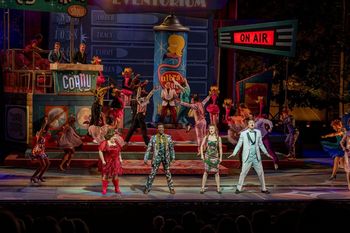
Without a doubt, the most thrilling night I have ever spent at the Municipal Opera in St. Louis was at this year's 108th season opener, Hairspray, in the 11,000 seat open-air venue in the city's Central West End. I'd call the Muny a venerable institution, dating back to approximately 1917. But so much of it looks brand new in the heavenly urban refuge of Forest Park. And once again, Seth Sklar-Heyn directs the first show of the summer, as he did with Les Misérables in 2024. This time it's the candy-colored, good old days of rock and roll–and Hairspray is the show that won't let go. This production stars the exuberant and meticulous Katy Geraghty as Tracy Turnblad: the chubby girl who wants it all, plus racial equality in the red-lined Baltimore of 1962. Jesse Robb choreographs dancers like they are some inexhaustible supply of bursting fireworks, bursting across the expansive stage in every hullabaloo moment. Evan Roider elegantly conducts the raucous-sounding band, with Christine Peters' great, cartoonish sets flying on and off and whirling around as dozens of singers and dancers and actors go into battle like they're storming the beaches on D-Day. I think this was also the first time I'd ever been to The Muny in over five decades where I felt a slight chill in the air. It is June in St. Louis, after all, amongst the trees and lagoons where the city hosted both the World's Fair and the Olympics in 1904. It's supposed to be like the tropics here in the summer! But what a lucky break for showbiz institution Richard Kind, who consistently finds fresh laughs in a wig and a dress in this two and a half hour delight as Tracy's mother, Edna Turnblad. The musicalization of the 1988 John Waters film feels a lot more streamlined and hard charging than the last time I saw it in a touring production, as if all the kids here are roaring out onto the playground at recess all at once. Sara Gettelfinger sweeps the board as supervillain Velma Von Tussle, who's staunchly in favor of segregation as the producer of the daytime dance program, "The Corny Collins Show." Here she's like a wicked version of Kay Thompson with her lanky limbs and smoker's voice, though Ms. Gettelfinger also has a remarkable high note in her first big song, "(The Legend of) Miss Baltimore Crabs," and blithely flings one leg over a "Hey Big Spender"-type railing in act two. Madison Thompson is terrific, pouty and smirking, as her daughter Amber, Tracy's arch-nemesis. The two high school girls fight over boy-toy Link Larkin, the equally unstoppable Ben Jackson Walker, and over supremacy on Baltimore's daytime TV (on stage, we gape at the everywhere-you-look video design by Nathan Scheuer, with lighting designed by Rob Denton). The show originally won eight Tony Awards, including Best Musical, for its Broadway debut in 2002 at the Neil Simon Theatre, with music by Marc Shaiman, lyrics by Scott Wittman and Mr. Shaiman, and a book by Mark O'Donnell and Thomas Meehan. And now Paul Schwensen is a grinning Olympian himself as Corny Collins, and Ashlyn Maddox and Nicholas A. Wilkinson make for a daring pair of mixed-race lovers as Tracy's friends Penny and Seaweed. Isn't it surprising that musical theatre is the main repository for the nation's soul right now? Charity Angél Dawson is flashy and towering as Motormouth Maybelle, Seaweed's mother and a force of nature on the Baltimore music scene. John Bolton and Mr. Kind get a swinging soft-shoe scene after intermission as Tracy's parents, Mr. Bolton reminding us a bit of Martin Short, and Mr. Kind (in drag) echoing Jimmy Durante in their lovely version of "You're Timeless to Me," choreographed by Mr. Robb. The musical arrangements are by Mr. Shaiman with orchestrations by Harold Wheeler, and this gentle number calls to mind the era's Billy May or Nelson Riddle and their work with Frank Sinatra. There's a heartwarming Hammond organ-type sound backing up Ms. Dawson's "I Know Where I've Been," and she sends the gospel style sky high here. Her stunning, shimmering gowns are by Tristan Raines, along with a couple of hundred other perfect costume pieces for this one-week production. The male dance chorus appears in wigs by Ashley Rae Callahan during the big women's tap dance of the damned in the funny jailhouse number, "The Big Doll House" after intermission. The fantastic back-flipping dancers in many of the big numbers are McKinley Knuckle and Matt Dean. And Joy Elizabeth Rhodes is excellent as Little Inez. In the 2007 movie based on the musical, of course, Martin Short played "Mr. Pinky," the dress shop owner, but here it's Kevin Zak (he also plays the glowering high school principal, the clueless TV show sponsor, and a jail guard here at the Muny), and his Mr. Pinky calls to mind the simpering Paul Lynde. Hannah Solow is great as Penny's mother, with a hint of a Kathy Bates-type maniac in her when she ties her daughter to the bed for going to the wrong side of town with Mr. Wilkinson, where the jumpin' and jivin' just won't quit. Ms. Solow (like all the rest here) makes all of her appearances, including her hard-nosed gym coach and jailhouse matron bits, seem the roles of a lifetime. There were about a half-dozen late mic cues the night I went (which is not unheard of). But, with all its flawless, live- projected images of black-and-white TV on stage, there's even a subtle commentary on the big role of the small screen in any Baby Boomer's life. And with all the men in dresses and wigs, there's perhaps even a more elliptical, though enlightened, approach toward our own present-day social issues than you'd expect to find in the Midwest. Mr. Kind, as Edna, scarcely wears any make-up at all, but couldn't be lovelier as Tracy's mother, steaming by a mountain of laundry or exulting over a beauty treatment in the giggly number "Welcome to the '60s" (backed-up by Taylor Colleton, Indya Lincicome, and Tatiana Lofton as "The Dynamites"). And director Sklar-Heyn has us flipping our wigs in another gigantic, super-modern, three-ring circus at the Muny. Hairspray, produced by the Municipal Opera Theatre of St. Louis, runs through June 21, 2026, at #1 Theatre Drive, Forest Park MO. Next week's show is Shrek The Musical. For tickets and information, please visit www.muny.org. Cast (in order of appearance): Swings: Dance Captain: Jennifer Florentino The Actors and Stage Managers employed in this production are represented by Actors' Equity Association Ensemble: Caira Carmelle, Chloe Chamberlin, Taylor Colleton, Brooke Cox, Audrey Curdo, Matt Dean, Trevor "TJay" Groce, Leah Joy Ifill, McKinley Knuckle, Indya Lincicome, Tatiana Lofton, TJ McCarthy, Jonah Taylor, Matthew Varvar, J'Khalil, Olivia Windley Youth Ensemble: Joylin Bass, AJ Bentley, Jaron Bentley, Elwyn Dignam, Deacon Edwards, Laila Factory, Natalie Fox, Kameron Henry, Danity Jones, Maya Levinson, Adaeze Loynd, Penny McPherson, Ami Miller, Kayla Montgomery, Madison Mountford, Gavin Nobbe, Landon Page, Jannah Rhodes, Henry Riggan, Eli Roberts, Solomon Rosenthal, Gia Smith Offstage Singers: Safiya Austin-El, Johanna Bishop, Sofia Chirco, Quentin Farquharson, Alexander Goa, Mark Hill, Megan Lawson, Norah Ward, Asher Woodward, Jerryt Young The Muny Orchestra: All Musicians of the Muny Orchestra are Members of Local 2-197 of the American Federation of Musicians Production Staff: Additional Production Staff: Sound Equipment Provided By: Masque Sound Special Thanks To: Blackheath Costumes 2026 Season Production Staff: 2026 Season Wardrobe Staff: 2026 Season Wigs: 2026 Season Music: 2026 Season Scenic: 2026 Season Lighting/Sound/Video: 2026 Administrative Staff: Summer Interns: * Theron Abel and Max Rodriguez are 2026 Carol B. Loeb Production Fellows ** Isai Leal and Charlotte Corcoran are 2026 Technical Intern Fellows, supported by Dan and Jodi Blake |