|
Regional Reviews: St. Louis A Brick and a Bible Also see Richard's reviews of The Children, Deathtrap, and The Black Feminist Guide to the Human Body
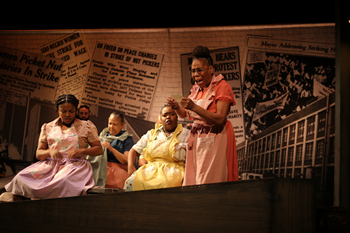
The show is only 70 minutes long, but full of honestly expressed ideas that stand the test of time. Written by local playwrights Kathryn Bentley and Colin McLaughlin, it smoothly tells the story of an historic labor uprising in St. Louis beginning in 1933. There's plenty of high quality acting, a bit of humor, and great singing arranged by vocal director Anita Jackson. Workers' wages at the R. E. Funsten nut company had been cut by nearly 74% in the years following the stock market crash of 1929 (the company was the largest employer of Black women in St. Louis at the time). And both pay and workplace conditions for them were even worse than for the Polish women who also separated pecan nuts from shells by hand with a knife in segregated areas at the Funsten factory on Easton Ave. At the same time, in contrast to the wage cutbacks, the company was making the present-day equivalent of six million dollars annual profit in 1933, according to The St. Louis Argus, a Black newspaper of the time. Perhaps it amounted to a "factory style" plantation, in an industrial town held by the Union Army sixty years earlier. Christina Yancy is terrific as Elizabeth, a young woman working there, in the true-life story of labor organizing in this famously blue collar town. (Growing up, I was told that only Detroit produced more cars than St. Louis in the decades after World War II.) The pro-labor musical is staged with precise direction by Ms. Cornell and stirring songs by Anita Jackson and Alicia Revé Like. The psychological journey of young Elizabeth and the others is often tender and meaningful, even scattered within Ms. Bentley and Mr. McLaughlin's proletariat dialog. Thomasina Clarke is a ball of fire as Delores, an outspoken labor organizer at the nut factory, exhorting Elizabeth to join the strike (there had been a failed walkout there in 1927). And there's plenty of atmospheric detail in every exchange, thanks to the playwrights. Alex Jay is striking in two very different roles: as Elizabeth's old schoolteacher, Ms. Leonard; and as one of the factory workers, Cora. And Ryan Lawson-Maeske is highly professional as the Communist Party representative Bill Setner. He seems entirely authentic, but his party's involvement sparks contempt among the churchgoing women. Then again, as Delores points out, neither the local Urban League nor the NAACP would come to their aid when first approached. And the real-life Mr. Setner had parents who both worked at the plant when he was growing up, making him part of their extended work family, for at least some of the women. Even in our age of vastly diminished labor unions nationwide, the earnest performances on stage make for a story of idealism and determination. The fine costumes are by Shevaré Perry, with an artistic, evocative set by Laura Skroska and projections by lighting designer Theresa Comstock. Josh Mayfield is steeped in the Black church as the women's pastor. And LaWanda Jackson, Adrienne Spann, and the wonderful Hassie Davis are factory workers with strength and spirit to burn. The struggle begins to seem worse than the work conditions, with a taut line of picketers fighting a squad of invisible St. Louis policemen in a confrontation that begins to look like modern dance. The intercession of Mayor Dickmann, at City Hall, is an odious affair for Elizabeth. At that political meeting, LaWanda Jackson's Carrie and Alex Jay's Cora have fine, shocked reactions at how the matter is being taken out of their hands. Ms. Jay's other character, Ms. Leonard, adds fine conflict, warning of lasting consequences for Elizabeth and her family. There's a recurring theme that dates back to just after the American Civil War: the still-present "Jim Crow" laws subverted Reconstruction, and the characters are still wrestling their way (in 1933) out of all of that. And Communism, perhaps, becomes the spanner they can throw into the works. Still, after all their fighting for equity, the nut company would move down to Texas for a cheaper workforce. But the persuasive message seems to be, "if you're not fighting, you're losing." A Brick and a Bible, produced by Bread and Roses Missouri, runs through February 22, 2026, at the Missouri History Museum, 5700 Lindell Blvd., St. Louis MO. The show moves to the Metro Theater Company beginning February 26, 2026, and then to St. Stephen's and The Vine Episcopal Church through March 8, 2026. For tickets and information, please visit www.breadandrosesmo.org. Cast: The Musicians: Production Staff: * Denotes Member, Actors' Equity Association |