|
Regional Reviews: St. Louis Rosencrantz and Guildenstern Are Dead Also see Richard's review of Robbin, from The Hood
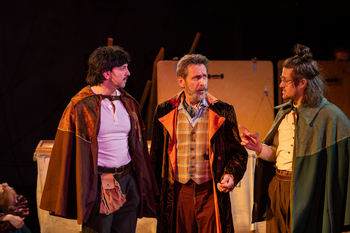
There may still be people who wonder why Stoppard, who died this past November, was so significant. But here's proof: a two and a half-hour play (with two 10 minute intermissions) that's a kind of window into the world of learned helplessness, but also a place where darkest predestination clashes with a lot of grimly funny stabs at free will. The latter two forces flip to become their opposite, over and over again, racing like an engine of absurdity. Or maybe it's just the comedic hell of two marginal characters caught inside of The Tragedy of Hamlet, Prince of Denmark, circa 1600. Take your pick, because it's funny on all those levels. Stoppard's inside-out version of Shakespeare's tragedy also reminds us of Samuel Beckett's Waiting for Godot, where existentialism hangs over its characters like a fog. But here, the "nothingness" and "meaninglessness" are closing in for the kill. In that sense, it's a perihelion of 1960s counter culture. There's a wealth of discovery on stage, or at least the desperate search for discovery, once the audience passes through a strange membrane replacing the usual proscenium arch. We enter the theater from "upstage" on Katherine Stepanek's deeply internalized set, to start our own interior Fantastic Voyage. The production puts the "or" in "to be, or not to be," turning that one little coordinating conjunction into a panicked fulcrum for nation-destroying power. What did their Germanic professors do to these three young men at Wittenberg, the college 300 miles south of Copenhagen? That's where this trio became pals, and apparently where they each were filled with so much doubt. The "thinking man's conundrum" is on full display as the flip of a coin develops into a matter of life or death. The play first appeared in 1966 at the Edinburgh Festival Fringe, now the world's largest performing arts gathering. Mitchell Henry-Eagles has abolished himself here, transforming into Rosencrantz and anxiously seeming to levitate with energy on stage, keeping the pace with exacting dynamism. Ryan Omar Stack is maddeningly affable as Guildenstern, garrulous and defiant against his co-star, confronted by bad luck with coin tricks and therefore free will. They are the Gogo and Didi of the English theatre, in a way that also manages to exalt this play's own English roots. "Words, words, words," as Hamlet says in the original play, but what words! He's just as grim and mysterious here, brought back to life by Sean C. Seifert, whose wit and defiance flash like lightning. And the words (mostly Stoppard's) come in blizzards of worry and wisdom. Hypnotized, we walk up metaphorical walls and onto rhetorical ceilings in all the wild reasoning. Jeff Cummings unleashes great, unexpected comedic skill as the actor-manager of a group of traveling players. And as Claudius, Eric Nenninger seems well on his way to getting rid of his troublesome nephew, the prince, with measured menace as the usurper king. Director Ridgely dives deep to find a whole new layer of awareness within the human condition: the membrane between will and action, perhaps the "or" made palpable. Joy Christina Turner seems slightly baffled, but eager to remain plugged-in to power as Queen Gertrude, wed in haste to Claudius (after the death of King Hamlet) and wearing a lovely sequined party dress supplied by costume designer Olivia Radle. Danielle Bryden, as Ophelia, makes the most of her limited time on stage with a perfect shriek of madness, at being spurned by the prince. And Lynn Berg has a taut obsequiousness in the script's downsized Polonius, advisor to the crown, thrown into a desperate new kind of foolishness. You have a sense he's probably quite intelligent, but can't stop what's coming. And I didn't see that coming. Rosencrantz and Guildenstern struggle to become real within the story (despite the title), pending the arrival of the melancholy Dane. But even after that, the pair seem like comical, desperate moths bouncing against a porchlight in the received glow of selfhood, like naive grifters in a thousand plays before this. The only flaw in the whole thing, if there is one, is that neither hope nor desperation (delightful though they are made here) seem to build between beginning and end. Trapped in a non-existent moment, Hamlet's friends are similarly victims of their own impressive wit. And the basic requirement of will, of merely escaping the grave, silently recedes from their grasp. In that sense, it is either the most tragic of dramas, or the purest of comedies. The traveling band of players is delightful, an entertainment that comes and goes, including Tielere Cheatem, Bryn McLaughlin, India Eddy, Mason Ramsey, and Ian Miller. The whole cast holds back an immortal moment against the waves of all our wills, as a glint of anticipation lingers in the air. Rosencrantz and Guildenstern Are Dead, produced by St. Louis Shakespeare Festival with Albion Theatre, runs through April 18, 2026, at the Kranzberg Arts Center, 501 N. Grand, St. Louis. For tickets and information, please visit www.stlshakes.org. Cast: Production Staff: * Denotes Member, Actors' Equity Association |