|
Regional Reviews: Chicago Leopoldstadt Also see Christine's reviews of Catch as Catch Can and Untitled Vampire Play and Kelly's review of Damn Yankees
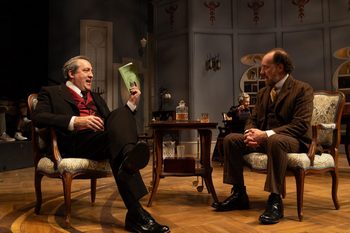
Leopoldstadt chronicles the lives of members of a Jewish family (and a few Catholics who married in, as the family's grandmother relishes pointing out) in Vienna over the first half of the twentieth century. The play's structure is episodic, with four movements set in 1899/1900, 1924, 1938, and 1955. Through this setting and structure, Stoppard spends Leopoldstadt exploring his most consistent theme: the disastrous effects of authoritarianism on the individual. Throughout, the main theme is filigreed with digressions into mathematics, philosophy, psychology, all tied together with Stoppard's trademark wit, making for a rich, dense, sometimes knotty work. Leopoldstadt is a bold play, but it's not a perfect one. Just on the level of logistics, with a huge cast of performers who sometimes play multiple roles, keeping track of who's who often necessitates flipping back to the chart in the program. But there are also some moments in the script that feel tonally inconsistent. Chief among these is a scene in the 1938 segment in which a Nazi officer arrives to inform the remaining members of the family that they have to surrender their home to the regime. In a play that's otherwise so nuanced and intricate, the Nazi character feels overly broad, a relic from Stoppard's uncredited rewrite on Indiana Jones and the Last Crusade. There's also a late-play revelation that recontextualizes a first-act betrayal that feels more contrived than textually motivated. These are small faults, but they clutter the play and slow it down. Still, these are quibbles, because Writers' Leopoldstadt is a masterclass in how the elements of a play should come together. Scenic designer Ken McDonald's set is beautiful, blending realistic detail with suggestive elements that allow for fast-paced staging. The space also transforms visually over the course of the evening, mirroring the family's suffering under the violence of the Nazis. When there's a jarring scenic and lighting transition during the 1938 section as we realize the Kristallnacht pogroms are breaking out, the moment has an incredible amount of emotional power. Likewise, director Carey Perloff stages the action briskly and captures the deep emotion in the text. If you wanted to criticize Stoppard's writing for something, it would be his tendency to intellectualize at the expense of feeling. Leopoldstadt is an intellectually sophisticated play, but it's also a very, very moving one. When we meet the Merz family, they're a large, happy group preparing to celebrate Christmas. They discuss the position of the Jewish people in Austria, and family patriarch Hermann argues that society is liberalizing and the Jews are assimilating. He believes the new century will see anti-Semitism slowly fade away. After all, his wife is Catholic, his larger family is only culturally Jewish, and they're preparing for a Christmas party. Of course, the audience knows what awaits, and the tension between our knowledge of history and this large, happy, multi-generational family onstage is brutal. This moment finds a grim echo at the play's end as the three Merzes who survive the Holocaust meet in the house in 1955. As they recite the names and fates of their kin, most of whom died at the hands of the Nazis, Rosa recalls the Christmas party from the opening. The full company returns, as do the Christmas trappings, and dances together as Rosa recalls her childhood. It's a chilling, marrow-deep evocation of theatre's power to weave together presence and absence, memory and present, fiction and history. The night I saw it, the theater was filled with audible sobs. This is Stoppard's genius: he is a playwright of ideas, but more importantly, he understands that ideas are only important if we care about them. Perloff handles these demands with aplomb, drawing the audience into the action with subtle stylistic shifts throughout the course of each of the movements. The cast, a who's who of Chicago theatre, similarly navigate the difficult text with an almost effortless grace. The play begins as almost a melodrama before ending as a memory play, putting a human face and cost on the broad sweep of history. Perloff and the actors are the Virgil leading the audience into the hell that humans create for one another. Lest that sound like a grim three hours, it's also often quite funny, and Stoppard never lost his gift for an incredible one-liner. If you agree with Aristotelian dramatic theory that the theatre is a venue for dialogue and debate, Leopoldstadt is a treasure trove. In this way, the Writers space is perfect for the play; since it's a thrust, you're looking at your fellow spectators as often as you are the action onstage. It's an ideal venue for the piece. As for the play, like a multifaceted jewel, you can appreciate it from a range of angles. It's a portrait of a society riven by a metastasizing nationalism, showing the barbarity of exploiting constructed social differences for political ends. It's a family drama about the importance of keeping your loved ones close. It's a meditation on tradition versus modernity. Somehow, it's also about math. In an age of theatrical diminishment–smaller casts, smaller ideas, shorter runs, less on all fronts–this play is a welcome change of pace. And with such a large cast and imposing scenic demands, Leopoldstadt is unlikely to get a bevy of productions in the near future. Stoppard's works have given audiences a great deal of pleasure, even if they offer very few easy answers. You'd be wise to see this one while you have the chance. Leopoldstadt runs through July 19, 2026, at Writers Theatre, 325 Tudor Ct, Glencoe IL. For tickets and information, please visit www.writerstheatre.org. The Cast: Justin Albinder (Zac/Nathan), Sam Bell-Gurwitz (Jacob/Leo), Ella Boparai (Young Sally/Mimi), Ian Barford (Hermann), Levi Charnay (Young Jacob/Heini), Hanna Dworkin (Poldi/Hanna; Understudy Emilia/Eva), Jessie Fisher (Hilde/Rosa), Sean Fortunato (Ernst), Kate Fry (Gretl), Erik Hellman (Fritz/Percy), Asha Dale Hopman (Young Rosa/Bella), Rachel J Jones (Ensemble; Understudy Jana/ (Sally/Wilma), Theo Clark Leber (Young Jacob/Heini), Hayes McCracken (Young Jacob/Heini), Morgan Medina (Young Rosa/Bella), Andrew Mueller (Otto/Civilian; Understudy Fritz/Percy/Ernst), Grainne Ortlieb (Jana/Sally; Understudy Hanna/Hermine), Sarah Coakley Price (Wilma; Understudy Eva/Nellie), Barbara E. Robertson (Emilia/Eva), Adeline Rosenthal (Young Sally/Mimi), Emma Rosenthal (Eva/Nellie; Understudy Hilde/Rosa), Sebastian Rus (Pauli/Young Leo), Caleb Scherr (Pauli/Young Leo), Joey Slotnick (Ludwig), Brenann Stacker (Hanna/Hermine), Ani Cohen (Understudy Poldi/Older Hanna/Ensemble), Jack Doherty (Understudy Jacob/Leo/Zac/Nathan), Ian Geers (Understudy Ludwig), Göran Norquist (Understudy Hermann; Otto/Civilian), Rebekah Ward (Understudy Gretl). |