|
Regional Reviews: Chicago Changing Channels Also see Christine's review of The Brief Wondrous Life of Oscar Wao and Samantha's review of Charlie and the Chocolate Factory
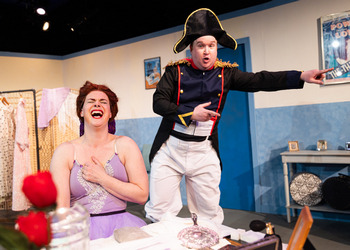
The play works as well as it does thanks to Reeger's sure hand in drawing on the touchstones of the era. The variety show is called "Your Show of Stars," and the "For Pete's Sake" sketch is quite clearly an homage to The Honeymooners. Moreover, Eddie Gilroy, the star comedian, is very much in the mold of Jackie Gleason and his comedic descendants, and there's more than a little Audrey Meadows in the character of Maggie Carlin, who plays his leading lady. In laying his cards on the table and acknowledging his inspirations so directly, Reeger frees the audience's attention from nostalgia scavenger hunt so they can focus on the reality of the characters and the situations in which they find themselves. Also to Reeger's credit is the fact that the play is not at all devoted to the stereotypes of the day. Eddie is most decidedly the kind of pain in the ass that such a person would have been, but he also genuinely admires Maggie's talent and has real affection for her. Maggie and her real-life husband, Pete, have a loving relationship of equals, and yet when Eddie accuses Pete of hiding his masculine insecurities behind political principles, it adds genuine, believable depth to the conflict. Reeger also intelligently rounds out his cast of characters, generating a remarkably nuanced reflection on the historical moment, with the inclusion of Bullets Bloomquist, Eddie's staunchly practical agent, and Kenny, an impressionable young stage assistant. Certainly, the moving parts of the conversation are easier to see with these characters, but the potential is there in the text to make them flesh and blood, and Theis and his cast certainly achieve this. It's true that the first act, sparkling and funny as it is, is stronger than the second, which veers dangerously close to preachy at times. And yet, both draw believably on the tradition of broad comedy and the trope of "very special episodes" of television. Furthermore, Reeger, Theis, and the cast have more than won the audience's patience for a more reflective tone in the show's later going. City Lit, as usual, provides an excellent staging for Reeger's play. Joe Larkin's set, supported by Liz Cooper's lighting and Petter Wahlbäck's sound, understands the assignment of a single location and the relatively short time frame. Maggie's dressing room is comfortable, but a little shabby. The two entrances onto the set, from the rest of the stage and from a bathroom, provide the visual promise of a door-slamming farce. Her costume rack and makeup table anchor the action in the 1950s and more subtly nod to the lack of privacy that complicates the characters' potential rise to fame. Emily McConnell's costumes are also a great asset. McConnell does an excellent job encapsulating the complexities of Maggie's on-screen femininity and Eddie's buffoonery. But it's also of note that the costume design turns the usual on its head in telling a story through what the men, rather than the women, wear in their "real lives." Kenny's wardrobe is a precursor of sharp business casual that signals his position as the next generation who will have to live with the outcome of McCarthyist paranoia and its consequences. Eddie's suits are wrestling with comedy and formality, and Peter's straight-laced attire in Act I speaks to his disheveled, but not quite casual, clothes in Act II as he confronts a life that may not have his wife in it. But the greatest gift to Reeger's strong text is the cast's skill in breathing life into it. This begins with Kat Evans as Maggie Carlin. Evans skillfully captures the reality that Maggie not only excels at the game of comedy and the business of it, but she enjoys both. She is eminently lovable in all her sharp edges, thanks to the charm of Evans' performance. As good as Reeger's script is, though, it's easy to see that Maggie's intelligence and savvy might read as too good to be true in the wrong hands. Fortunately, Maggie is certainly in the right hands here. Evans' performance quite rightly hinges on that of Orion Lay-Sleeper as Eddie Gilroy. It's easy to see how a less subtle script, less capable direction, and a less well-executed performance might set Maggie and Eddie up as antagonists whose "friendly" interactions are entirely disingenuous. Lay-Sleeper and Evans, however, are quite wonderful together from the first anxiety-provoking moment when it seems as though Eddie might truly intend to abuse Maggie for the sin of saving him when he forgets his lines. There is a risk for the Eddie character, in particular, that the slightly weaker second act might compromise an actor's performance, but Lay-Sleeper retains Eddie's strong pull toward what is easy, even as the character genuinely grapples with what is right. Skyler Tipton as Maggie's husband, Peter Bell, is a great complement to both Evans and Lay-Sleeper. His cheerful gratitude for the roles he continues to land in radio dramas, as well as his delight in Maggie's performances in a medium he doesn't really understand both come across as genuine without being naïve. Similarly, his wariness toward Eddie never lapses into stereotypical jealousy or masculine competition. Through Peter, we learn about Maggie's professionalism and Eddie's devil-may-care approach, which sets the stage for these two characters' disparate attitudes toward signing the "Loyalty Oath" that CBS demands of them. Andrew Pappas (Kenny) and Johnny Moran (Bullets) also provide performances that are important to the show's success. Moran is faced with, perhaps, the flattest material, but he breathes life into the "man on the street" concerns that render the panic of the time legible, if not forgivable. On the other end of the spectrum, Pappas (like Moran) flexes broadly comedic muscle while conveying how important it is for someone to take a stand, thus guiding the young and impressionable on to the righteous path. Changing Channels runs through April 12, 2026, at City Lit, 1020 W. Bryn Mawr, on the second floor (accessible via elevator) of the Edgewater Presbyterian Church, Chicago IL. For tickets and information, please visit www.citylit.org or call 773-293-3682. |