|
Regional Reviews: Chicago White Rooster Also see Christine's review of Changing Channels
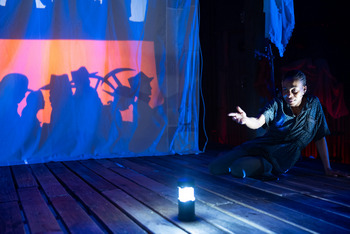
The overarching story focuses on Min, a young woman fascinated by the presence of someone or something in the attic of her family home. Maria and John, Min's parents, deny even hearing the footsteps that draw Min to play a handclap game with the entity beyond the attic door. Despite the strength of this pull, Min voices her determination to leave the house and the town altogether, forcing the hand of "June," who instructs Min to make her way to the entrance of the town's defunct goldmine and offer a gift to the drunken man she finds singing there. Min complies and encounters Pong, a good-humored young man who is enabling John's obsessive digging. Pong eventually helps Min lure John back home, and as payment for his help in this and in fixing a fence, Maria offers a story of the town, years ago, in the throes of a drought, when Maria ultimately offered herself to the demon behind the crisis. This story, combined with the attraction between Min and Pong, acts as a terrible catalyst: Min's home is burned to the ground. Pong and John are relentlessly compelled to return to the mine to dig, and the two, along with many others from the town, ultimately die when the mine collapses. Maria, driven further into madness by these events, disappears and Min finds herself trapped by Pong's grandparents, Judy and Hao. Whatever emotional reaction to their grandson's death these two might have, they eagerly prey on Min's grief, guilt, and vulnerability, ultimately trapping her into a ghost marriage with Pong in the form of a white rooster, to ensure that Min will feel compelled to care for them in their old age. This arrangement evolves into something no one expected. Min, who is caught between loneliness and humoring her new "in-laws," talks to the rooster as though he were actually Pong. When the rooster speaks to her in Pong's voice and offers a chunk of gold, Min takes it to the town's "holy man" in search of answers. A magic spell results in Pong's resurrection as a monstrous half-rooster creature who is then swept up in the townspeople's drinking, dancing, and general debauchery. Min eventually happens upon her mother as she emerges from the mine, and it comes to light that Min's father has somehow also been resurrected. The two have been frantically and mindlessly stealing children to feed to June, their "imperfect" child. Stories of hunger, betrayal, and reincarnation spill out, culminating in Min's love for her twin, putting the town's curses to rest and freeing her to pursue her own destiny. Natsu Onoda Power's scenic design is quite wonderful, consisting of a slatted, two-level structure that serves as various houses around the town; the slats are replicated along the walls of the theater space and hung with various props and costume pieces, as well as an electric guitar and a nylon-string guitar that cast members retrieve and employ at various points. A system of white sheets and pulleys transforms the set into various different spaces, both real and mythological, as well as providing the backdrop for sophisticated shadow puppetry (puppet design by Caitlin McLeod) and facilitating the integration of practical puppets, which range from simple figures on sticks to elaborate, full-body figures operated by multiple cast members. Hannah Wien's lighting design capitalizes on the set. Actors wield flashlights to bring stories and images to life. The traditional stage lights seep up through the slats, pulsing gold to evoke the persistent pull of the dry mine or red to represent anger, hunger, and passion, both recent and ancient. Similarly, the sound design by Justin Cavazos (also credited as co-composer alongside Lee) keeps the action floating in productive liminal space, particularly supporting the rhymed sections of dialogue that help to weave the various stories together. Mara Blumenfeld's costumes establish the characters as dwelling in a nonspecific past, and the specialty ensembles for Rooster/Pongo as well as the holy man are stunning. As Min, Sunnie Eraso embraces the task of bringing the two-dimensional folktale girl to life. Eraso successfully treads the line between acknowledging the absurdity of her situation and surroundings without disrupting the spell. Eraso's physical work with Noelle Oh (June) is especially impressive and demonstrates the range of both performers. As Min's parents, Maria and John, Karen Aldridge and Mark Montgomery create the maddening dream logic that characterizes the older generation in the cursed town. Aldridge's storytelling is masterful, and although her character is heightened from the very beginning of the play, Aldridge still elicits sympathy. Montgomery's performance rests on a broadly comedic base that he develops with great skill, even as he taps into both the horror and the melodrama of the various stories. Louise Lamson and Daniel Lee Smith mirror the success of Aldridge and Montgomery in their portrayals as Judy and Hao, Pong's grandparents. Lamson's deadpan delivery is as perfectly executed as Smith's slapstick approach. Smith's performance of the "pork ghost" tale is also remarkable. Reilly Oh has one of the play's more difficult tasks in portraying Pong, who is the least developed of its characters. Nonetheless, Oh generates the easy charm that makes it believable that Min would fall for him, despite all the red flags his character raises. In the character's monstrous, reincarnated form, Oh effectively ramps up the desperation as quickly as the script demands. Elliot Esquivel does excellent double duty as both the comedic holy man and the young hunter that Min seems to spark to, even as she tries to cope with the absurdity around her. Esquivel's blend of laconic cowboy and generic mystic is riotously funny without compromising the horror, and his easy, slightly dim-witted sweetness works well against the backdrop of Reilly Oh's pre-reincarnation Pong. White Rooster has been extended through April 26, 2026, at Lookingglass Theatre, 821 N. Michigan Ave., Chicago IL. For tickets and information, please visit www.lookingglasstheatre.org or call 312-337-0665. |