|
Regional Reviews: Minneapolis/St. Paul The Giver Also see Arty's reviews of Guys and Dolls and In the Green, Deanne's review of Forts! Build Your Own Adventure, and and Renee's review of Les Misérables
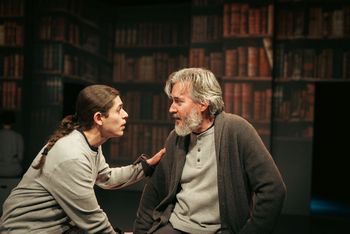
The novel has had an expansive reach but has not been without controversy. A 2012 School Library Journal survey named it as the fourth best children's novel of all time, and it has been incorporated into the core curriculum reading list of many middle schools in the United States, Australia, and Canada. Yet it has also been harshly criticized and frequently challenged in school libraries and on reading lists for being too grim, too violent, and dealing with controversial moral issues. Open Window Theatre, never afraid to raise moral questions on its stage, is giving us the opportunity to weigh in with its current production of the stage version of The Giver, directed with a sense of purpose by Zach Christensen. Coble's script, though lacking the texture and nuance of Lowry's book, closely follows the novel's narrative. At the onset, it introduces us to a bleak world. On stage (the set design is by Robin McIntyre), we face a barren landscape lacking color or variation, nothing but a rear gray wall punctuated by several open doorways and unadorned cubes that serve as chairs, tables, and storage bins for props taken out as needed. This community, in which The Giver unfolds, maintains that such bareness equates to a virtuous "Sameness" (the word is used as a noun), removing envy, competition, and discord from life. It is believed to be a utopian existence. We see Jonas, our nearly 12-year-old protagonist, with his family: Mother, Father, and younger sister Lily. Father works as a nurturer, caring for infants at a government facility until they have developed enough to be assigned to a family–only two per family. Theirs is a society that denies any differentiation in life. At dinner they report any feelings they had during the day, followed by instructions to quickly negate those feelings and maintain an untroubled continence. In the morning, the same routine applies to any overnight dreams. Feelings are to be excised, like ridges smoothed out of a bedspread on a made bed. Jonas and his best friends, Asher and Fiona, are about to turn 12 and therefore receive their assigned life's work, determined by the Council of Elders. They are nervous about how they will spend the rest of their lives, but told not to worry because the Elders observe each child's gifts, and never make mistakes. That the children are being observed is made obvious by public address announcements to the entire community that make note of the smallest infraction by any one of them. When Selection Day comes, Jonas is chosen for the most responsible of all positions: to be the next Receiver of Memory. This role requires intensive training by the aging Receiver of Memory who tells Jonas to call him the Giver. He will pass on to Jonas all the memories of humanity's past pain, pleasure, sorrow, and joy, freeing the rest of the community from the burden of memories and the feelings they trigger. Only the Giver, and now Jonas, see colors and experience the feelings that accompany horrors such as war or hunger, or the exhilaration of sledding down a hill, or the joy of love. Holding all this within himself seems, to Jonas, a terrible burden, and he begins to commit the worst possible offense: questioning the way things are. The premise is rife with the specter of a society drained of its humanity. Coble's script does not animate the characters, outside of Jonas and the Giver. We are left without a sense of repressed feelings and a dearth of experience among Jonas' family and friends, so that they only appear to be pathetically shallow. And yet, because our own experience tells us how much those who submit to the "Sameness" have lost of their humanity, we are left with a chill down our spine. For instance, in a scene in which Jonas admits to having "stirrings" for his friend Fiona, his mother counsels him that such feelings are normal at his age and that he will take pills to eliminate them. The scene is extremely well played by Samuel Osborne-Huerta as Jonas and Deanne McDonald as Mother, but the realization that this adult woman, a wife and mother, accepts that the total suppression of sexuality is normal, good, and necessary, with not a whiff of regret, is greatly disturbing. Likewise, when Father, played with apt cluelessness by Sam Sweere, bids a cheerful "bye-bye" to Gabriel, a baby that has not met its developmental benchmarks by the established timeline so must be "released" from the community, his insipid farewell makes the act all the more horrifying. Jonas and the Giver are the only characters with complexity, and who appear to be actual human beings and not AI robot humanoids. They are the only ones with the presence of emotions beyond gentle satisfaction or mild disappointment. Keith Prusak is compelling as the Giver. We feel his palpable sense of relief to at last have someone, in Jonas, with whom he can share his burden, and who can also experience the joys and pleasures that a world of "Sameness" has abandoned. When he realizes that, through Jonas, there is hope of change, his passion is all encompassing. Osborne-Huerta has been showing up on Twin Cities' stages almost non-stop in a wide range of roles over the past couple of seasons, gaining depth and authenticity each time out. Here, he is completely persuasive playing an adolescent entering the dystopian system with innocence, possessed of the intelligence to raise questions and the fullness of heart to fight for change. As Mother, McDonald conveys a sense that she is withholding some knowledge beyond what "Sameness" permits, but that she is solidly committed to the laws of the community. She is a caring, but not a loving, mother. Sweere's Father exhibits even less of what one would call caring as a father, more like being among agreeable company when his children are present, like playmates one enjoys spending time with, but who can as easily be replaced by other playmates. Nate Farley designed costumes which accentuate the lack of choice and diversity among members of the community, with the Giver standing out in stark contrast. Alex Clark's lighting and projections design turn the Giver's quarters into a repository of wisdom, lined with books and colors that, again, suggest a last bastion of civilization in peril of being erased. Jeremy Stanbary's sound design, including those public address announcements and the chaotic background noises that set the tone at the start of the play, further enhances the production. While Lois Lowry might not have anticipated artificial intelligence when she wrote "The Giver" in 1993, she certainly appears prescient in conceiving of a society in which our futures may be determined by a calculation on how we seem and how we have acted in the past, rather than allowing for actual feelings and for learning from the past. Her dystopian vision is one of passivity, with choices that should be heartwrenching turned into protocol. In that world, individual choice is no longer a right, or even an option. There is no place for "love" in this universe, or any mention or space for spirituality. Morality is narrowed to following what the Elders, in their "wisdom," have laid out for the populace. That Lowry on page and Coble on stage have created a character inspired and able to take a stand against this order sheds a glimmer of hope for brighter days to come. The Giver runs through March 22, 2026, at Open Window Theatre, 5300 S Robert Trail, Inver Grove Heights MN. For tickets and information, please call 612-615-1515 or visit openwindowtheatre.org. Playwright: Adapted by Eric Coble from the Newberry Award-Winning novel by Lois Lowry; Director: Zach Christensen; Set Design: Robin McIntyre; Costume and Props Design: Nate Farley; Lighting Design: Sue Berger; Sound Design: Jeremy Stanbary, Lighting and Projections Design: Alex Clark; Assistant Director: Jeremy Beveridge; Stage Manager: Elle Rowe; Assistant Stage Manager: Josh Row. Cast: Caiti Fallon (Fiona/Rosemary), Deanne McDonald (Mother), Ahmad Mohamad (Asher), Sophia Nelson (Larissa/Chief Elder), Samuel Osborne-Huerta (Jonas), Keith Prusak (The Giver), Sam Sweere (Father), Kira Walk (Lily). |