|
Regional Reviews: Minneapolis/St. Paul Symphony of Rats Also see Arty's reviews of Kimberly Akimbo, The Cake, and The Giver
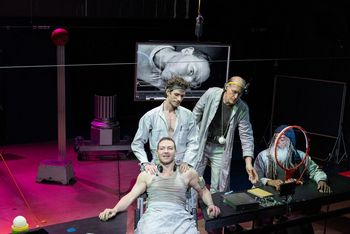
A vital disclaimer: the show we saw at the Walker is not the same show audiences saw at the Performing Garage in 1988. In 2021, Wooster Group directors Elizabeth LeCompte and Kate Valk reached out to Foreman, who died January 4 of last year at the age of 87, and asked him if they could make a revised version of Symphony of Rats. His response, quoted in the program notes, was "You can do whatever you want! I hope it's completely unrecognizable." LeCompte and Valk have worked their artistry and direct the current edition of the show. I am, unfortunately, not able to report what changes they made, but consider that in 1988 when the original work was created, our head of state was Ronald Reagan, with George H. W Bush on deck. In 2021, we were coming off four years of Donald Trump and MAGA-ism, shifting gears markedly to Joe Biden. The revised version premiered early in 2023, with Biden still in the White House. By the time we saw the new Symphony of Rats, Trump and company were not only back in the seat of power, but acting faster and looser with the authority they perceive it allows them. It is difficult to see Symphony of Rats without straining for connection to who and what we are currently dealing with, relative to power in the United States. The main character in the play is called The President, and he spends the great majority of the 75-minute show seated on a portable toilet (speaking of "seat of power"). Our current president, it has been reported, awakens at night and communicates with the world (not just his American subjects, but the world) via social media, especially on the platform he created and named "Truth Social" as if branding it as such makes the claim real. But in Symphony, the The President comes across as an everyman, overwrought by the abundance of new input, means of expression, and dangers. Set in a space that looks like the merger of a science lab, a media center, and a gymnasium (LeCompte is credited with production design), festooned with video monitors, cables, and basketballs, The President makes connections with signals from other planets in other universes, outside the confines of the known world. It turns out, making the connections is one thing; making them meaningful is another. Played by Ari Fliakos with deadpan stoicism, The President seems more a victim of the avalanche of information and media than a nefarious manipulator of it. He willingly endures all manner of experimentation and indignity to gain mastery of it, though mastery is elusive. His appearance is hardly presidential, for he shows up in a canary-yellow rain jacket, a threadbare mud-toned muscle shirt, athletic pants, and sneakers (Antonia Belt designed the costumes). None of the other persons on stage are named, and their exact roles are fairly nebulous and also shift in the course of the show. There is a figure who seems nominally in charge of the endeavor (Jim Fletcher), who operates much of the equipment and selects much of the media feed. For some, but not all of Symphony, he wears rats' ears. Another person (Guillermo Resto) has the full, white beard, unshorn hair, and long robe of an aged Renaissance astronomer. Much of his dialogue consists of repeating what someone else said, in a profound basso voice, speaking through a basketball hoop turned on end to encircle his face like a frame. Then there are the two lanky young men played by Niall Cunningham and Andrew Maillet. Curly-haired, barefoot, and open-shirted, they seem to be attendants to The President, sometimes assisting in his projects, sometimes goading him into action, sometimes merely observing. A woman (Michaela Murphy) is seen on stage, discretely, it appears, taking notes on the proceedings until, nearing the end, she reveals herself as an aggressive seeker of carnal relations, with a fabricated phallus (it appears to be made of felt and stuffed, like a teddy bear) subbing for The President's member. There are extremely inventive uses of video footage (the work of Yudam Hyung Seok Jeon, with additional video by Andrew Maillet). It is, in turn, spooky, provocative, or comical, and often all three. It is sometimes interactive with the humans on stage. An especially vivid example is when The President defecates (remember, he is seated on a toilet) into a pan affixed beneath the toilet, aided by the rat-eared person, who "feeds" the output into a video screen airing a cooking show. The upbeat host of the show uses the substance to bake cookies, then, in a bit of slight-of-hand stage magic, rat-ears receives a finished "cookie" from the screen, holds it up for us to see, and proceeds to eat it. I bet you haven't seen that on stage before. In addition to TV cooking shows, Symphony of Rats draws on other cultural touchstones, including Star Wars, William Blake, and Charlie Chaplin's film The Great Dictator, creating its own version of the iconic scene in which Chaplin, in the title role, does a ballet with a large world globe–only here, the globe is reduced to the size of a beach ball. The President seems to relish experiencing the earth as a lightweight sphere he can control with ease, even with grace, but like every phenomenon in Symphony of Rats it is ephemeral. To be honest, I can't say that I understood everything going on in Symphony for Rats, and when I did have an understanding of what I was watching, I am not confident that my understanding matches what Foreman, or LeCompte and Valk, had in mind. I also am not sure that matters, though for those who like a narrative with a logical, lucid through line, Symphony for Rats may be a long slog. I relished its imagery, inventiveness, irony, raunchiness, whimsy, and provocation. If those ingredients appeal to you, Symphony of Rats may be your dish, or even suffice as a meal. I also welcome a vision of a president who is seeking input, rather than only dispensing output. As I stated above, it is hard to view Symphony for Rats without stacking it up against the images that flood our TV, computer, and phone screens, and to form our understanding of this mystifying work from that vantage point. Symphony of Rats, produced by The Wooster Group, was presented February 25, 2026, through February 28, 2026, as part of Walker Art Center's 2026 Out There series. Performances were in the Walker's McGuire Theater. For more about the Walker Art Center, please visit www.walkerart.org. For more information about The Wooster Group, visit www.thewoostergroup.org. Text: Richard Foreman; Composed by: The Company; Directors: Elizabeth Lecompte and Kate Valk; Production Design: Elizabeth Lecompte; Costume Design: Antonia Belt; Sound Design and Music: Eric Sluyter; Lighting Design: Jennifer Tipton and Evan Anderson: Additional Lighting Design: David Sexton; Video Design: Yudam Hyung Seok Jeon; Additional Sound and Video: Andrew Maillet; Dramaturg: Matthew Dipple; Assistant Director: Michaela Murphy; Production Manager: Aaron Amodt; Producer: Cynthia Hedstrom. Cast: Naill Cunningham, Jim Fletcher, Ari Fliakos, Andrew Maillet, Tavish Miller, Michaela Murphy, Guillermo Resto. |