|
Regional Reviews: Minneapolis/St. Paul Abuelita Also see Arty's reviews of Don't Bother Me, I Can't Cope and Sleuth and Deanne's review of Dinosaur World Live
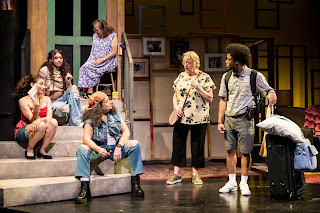
Amidst that heat wave, 72-year-old Davia and her 15-year-old grandson Jesús show up at the stoop of a five-story walk-up apartment building, straight from their farm in Iowa. Davia is white. Jesús is Black, being the offspring of Davia's daughter, who was a meth addict, and a Nuyorican (Puerto Rican New Yorker) man she met after fleeing the fetters of Iowa for the big city. She returned to Iowa with her baby in tow, leaving Jesús primarily in care of his grandparents until she died in a violent drug-related incident. Jesús has never met his father. Growing up in rural Iowa is hard for Jesús. As the only person of color in his school, he was subject to cruel racial taunts and harassment by classmates, isolated from the social circles of his peers. He is a good student and avid reader whose favorite authors include Steinbeck and Faulkner. When his grandfather died, Davia decided to sell the farm and move to New York so Jes could be among other persons who looked like him, soak up his culture, learn to speak Spanish, and be with "his people." Davia and Jesús are greeted by their new neighbors: Niego, Indigo, Yvette, and Sonya (Yvette's granddaughter). They are sitting on the stoop to catch whatever breeze can relieve the heat–the power is out, so there is no air conditioning. Davia assumes that the power being out also means the elevator isn't operating until her laughing neighbors tell her that "walk-up apartment" means there is no elevator, power or no power. Davia has a lot to learn about the city, but she is game and eager to help Jesús feel at home there. She encourages a friendship between him and Sonya, who is close in age and as wise to the ways of the street as Jesús is naïve. The last character we meet is Wilfredo, a Cuban-American who lives next door to Davia and Jesús, and whose conga drum playing easily pierces the walls between the two apartments. In various combinations these characters interact and find common ground–Davia and Yvette over their unsought responsibility for raising their grandchild, Indigo and Davia over past love lives, Davia and Wilfredo over conga lessons, Indigo and Jesús over literature (though Indigo urges Jesús to quit Steinbeck and Faulkner in favor of James Baldwin and Alice Walker), and especially between Sonya and Jesús. Sonya teases Jesús about his attire (savvy costume designer Caroline A. Zaltron has him initially dressed in clothes I recall seeing at J.C. Penney in 1993), the formality of his speech, and his lack of social ease. A self-proclaimed fashion maven, Sonya takes him under her wing to transform his look, as well as to teach him to dance and to accompany her on her frequent forays to Greenwich Village where she hangs out with her friends–in the Village and on the piers frequented by cruising gay men. When a crisis occurs and Davia becomes panic stricken over Jesús' safety and wonders if leaving Iowa was a mistake, the others reach out as a community to support and assist her. Abuelita attests to the power of community and the importance of honest communication. Both Davia and Jesús come to embrace change and to realize the power and the beauty unlocked by loving their true selves. Shá Cage's direction constructs that community with each individual's uniqueness coming through, while their personalities mesh to create the united front so essential to this story. Scenes transition smoothly, with simple alterations to the set (designed, along with props, by Jacelyn Stewart) establishing a change in location. "Abuela" is Spanish for grandmother, and "Abuelita" indicates a little, or more colloquially, a dear grandmother. Davia is the heart of the play. Displaced even in Iowa–she retains a drawl from growing up in the South, having met her Iowa-bred husband while both served overseas in World War II–she has chosen to transform herself from grandma to Abuelita in order to give her grandson the gift of his heritage. Mary Gant is wonderful at bringing this deceptively complicated woman to life, bit by bit revealing the unlikely elements that have formed her journey. She conveys the naivete of a country gal unversed in the city, but tempered by a resolve to figure it out and make a go of it. King Jackson, making his professional performing debut as Jesús, is terrific as the character persuasively shifts from a fish-out-of-water kid from Iowa to an assimilating teen who dresses and moves like he belongs in the hood, and a love-hungry boy thrilled by the realization that someone finds him beautiful. Skylar Seiler is delightful as Sonya, enthused with the prospects of her life, including repeat viewings of Jurassic Park and working Cinderella-like magic to transform Jesús from country to ghetto. Gabi Del Moral is warmly winning as Yvette, accepting the privations of life in a Spanish Harlem walk-up and offering a safe harbor to the lost-at-sea Davia. Adlyn Carreras crafts a complicated portrait as Indigo, a role that could have been a simplistic stereotype but, thanks both to Carreras' performance and Yungerberg's script, becomes a multi-dimensional character able to connect with someone as different from herself as Davia. Pedro R Bayón is convincing as conga-thumping Wilfredo, whose gruff demeanor conceals a wounded and deeply sensitive man. Ella Vega Pérez gives a fine showing in the underdeveloped role of Niego. Mik Finnegan's sound design provides the production with authentic sounds of the inner-city streets, along with a wide range of music, from salsa to Simon and Garfunkel. Shannon Elliot's lighting design tempers the scenes with changes in the time of day, as well as the emotional tone. Nathan Yungerberg has written a gripping narrative, with characters and dialogue that feel genuine. A conversation between Davia and Jesús about safe sex, for example, feels pitch perfect. However, Abuelita suffers from a few minor gaffs that mar its authenticity. For example, while Sonya is clearly a live-wire teen, nothing about her indicates why she finds her peers in the Village and the Piers, so far from Spanish Harlem. The character Niego adds little to the play, other than a few snappy remarks, and one wonders what more she might have contributed to the narrative. Also, a scene in which Wilfredo walks through the theater's orchestra and up on stage to enter his apartment serves no clear purpose, and we are left wondering "what was that about?" Throughout the play, Davia turns to alcohol frequently to relieve her stress–one of the first things she asks Yvette is if she has anything stronger to drink than lemonade. The frequency of her drinking begs a question as to whether Davia self-medicates with alcohol as a way of dealing with issues in her life that are gradually revealed, but the play doesn't pick up on this. These are minor blips in what is a sound and engrossing new play, but some dramaturgical refinement might make it an even better one. That said, Abuelita is well worth seeing for its fresh and appealing narrative, strong and original performances, and depiction of an authentic community. We in the Twin Cities have so recently been through–and, truth be told, continue to experience–the importance of community in providing safety and a sense of belonging across boundaries of race, nationality, language, gender identity, and religion. Nathan Yungerberg gives us an informed view of an on-stage community, one that inspires hope for communities in the real world. Abuelita, presented by Prime Productions, runs through March 29, 2026, at the Capri Theater, 2027 West Broadway, Minneapolis MN. For tickets and information, please visit www.primeprods.org. Playwright: Nathan Yungerberg; Director: Shá Cage; Assistant Director: E. G. Bailey; Scenic & Props Design: Jacelyn Stewart; Costume Design: Caroline A. Zaltron; Lighting Design: Shannon Elliott; Sound Design: Anita Kelling; Dialect Coach: Andres Chulisi Rodriguez; Technical Director: Austin Stiers; Stage Manager: Amanda Oporto; Assistant Stage Manager: Paola Nuñez Obetz. . Cast: Pedro R Bayón (Wilfredo), Adlyn Carreras (Indigo aka Milagros), Gabi Del Moral (Yvette), Mary Gant (Davia), King Jackson (Jesús), Miriam Monasch (Davia understudy), Elsa Vega Pérez (Niego), Skyler Seiler (Sonya). |