|
Regional Reviews: Minneapolis/St. Paul Don't Bother Me, I Can't Cope Also see Arty's reviews of Sleuth, Waking Miss Daisy, and Strange Heart: The Songs of John Berryman and Deanne's review of Dinosaur World Live
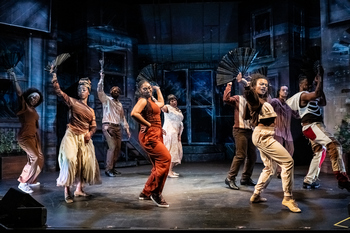
Well, that was fifty-two years ago (Can that really be? I must have been incredibly young), and I was delighted to learn that Penumbra Theatre was bringing back this gem of a show, directed by 2024 President's Lifetime Achievement Award recipient Patdro Harris, but I also wondered how what was strikingly current in the 1970s will play out in 2026? I say "wondered," not "worried," as I had confidence that the reliably insightful instincts that guide Penumbra's work would carry the day, and they have. Don't Bother Me, I Can't Cope storms the stage with a profusion of music, soaring vocals, mesmerizing dance, and a spirit that proclaims, "We are talking about TODAY!" Don't Bother Me... was created–book, music, and lyrics–by Micki Grant, working closely with director Vinnette Carroll, founder of the Urban Arts Corps. Grant was an accomplished actress on the Off-Broadway scene, appearing in works by Jean Genet and Bertolt Brecht alongside such stars-to-be as James Earl Jones and Cicely Tyson. Don't Bother Me... was the first show Grant created. It was grounded in the nitty gritty of African American urban lives, but what was transmitted to the audience were the feelings attached to that life, not dependent on particular names, places, or events. And feelings endure, feelings that are just as much an expression of today as they did then. To ensure that Don't Bother Me... speaks to today's audience, some of the songs have been adapted and given new arrangements by music director Sanford Moore. "Slow Blues (History of Dance)," which starts off with the blues and shimmies through every dance craze to hit 125th Street (choreography by Angel Ceara Clark), such as the Charleston, swing dance, the jitterbug, rock & roll, and the twist, moves on past 1972 to 2026, with disco, hip-hop, vogueing, techno, afro-beat, hip hop-fusion. Projections (designed by Mike Simmons) of images to complement the songs include events and icons of the sixties and seventies but, again, are extended up to the minute, including a banner demanding "ICE Out." Don't Bother Me... claims to have a book–indeed, it was the first Broadway show to be wholly created (book, music, and lyrics) by an African American woman, and Grant was separately Tony-nominated for her score and her book, in addition to the show being nominated as Best Musical and Vinnette Carroll's nomination for Best Direction of a Musical. But back in 1974 and now in 2026, the "book" eludes me. There is virtually no spoken dialogue, no characters with clear identity, and no through-narrative. I think of Don't Bother Me... as a revue, with songs either in a self-contained scene, or two or three songs linked together in a common theme, most with accompanying dance. Angel Ceara Clark's choreography is terrific, turning muscular, or playful, as suits the scene. Director Harris stealthily shapes the flow from one song to the next. Sometimes this means a transition so subtle as to be seamless, and sometimes keeping the same theme in play from one song to the next. Other times the new song brings a stark break from one mood and theme to another, embellished by Marcus Dilliard's complementary lighting design. Every bit of it is moving, accomplished, and wow-oh-wow entertaining. The nine cast members perform with phenomenal talent and energy. They project the feeling that there is nowhere in the world they would rather be than up on that Penumbra stage; nothing in the world they would rather be doing than singing these songs, dancing these dances, and expressing these feelings; and that there is no one else they would rather bring their musical and theatrical gifts to than this audience. Don't Bother Me... is an ensemble piece, but Aimee K. Bryant stands out as the leader among equals. Bryant soars on vocals, including her superb "Billie Holiday Blues," delivers the humor in the piece with sly confidence, and emits a kind of maternal presence throughout the show. Darius Gilliard makes the soaring "My Name Is Man" a bona fide showstopper, and Nisi Collins conveys the pangs of a searching heart in "Questions." Austene Van sings with utter soulfulness, starting with "Goin' to Town This Morning," and dances with leonine grace. With the gusto and soaring voice of a clergyman, Charles Holt takes the guise of a preacher in a sequence that links "Good Vibrations," a spirited celebration of Black spirituality, flowing into "Prayer," a more personal request for divine intervention. Daonna Lewis and Demetrius McClendon are paired several times as dancers, including a pas de deux of sublime beauty. The full ensemble pieces wield considerable power. These include the opening, "I Gotta Keep Movin'," that starts with Darius Gilliard lashing out a soulful, slow spiritual, with other cast members taking turns on the verses, and then, boom, it breaks into joint-is-jumping R&B with the whole cast on board. In the title song, each cast member brings up one of life's indignities, from the trivial to the existential, all of them vexing, but no one allows themself to be brought down. The upbeat "Time Brings About a Change" underscores the belief that change will be for the better. "They Keep Coming" is an a capella march, punctuated by the percussion of stomping feet, affirming that, in spite of the obstacles, the African American community continues to grow and make progress. "Fighting for Pharaoh" is a protest song stating that after millennia of being made to fight other people's battles, it is time for Black men and women to fight for themselves. Sandford Moore is at the keyboard and leads the four-piece band, playing the many musical styles in Grant's score, from blues to gospel to calypso, from soft rock to R&B, to funk. Lance Brockman's set is a functional depiction of an urban block lined with doors and windows, some of which open to allow performers to evocatively stand in a door frame or sit on a window ledge. Costume designer Wanda Walden has dressed the cast to feature the range of style one might see on the streets of an African American neighborhood, with a change of costumes in Act II. Jamakah Webb, as wigs and makeup designer, provides a similar diversity of hairstyles. Don't Bother Me, I Can't Cope is a joyful and entertaining celebration of pride, of community, and of hope, that lifts both the roof and the hearts of those beneath the roof at Penumbra. Highly recommended. Don't Bother Me, I Can't Cope runs through April 5, 2026, at Penumbra Theatre, 270 North Kent Street, Saint Paul MN. For tickets and information, please call 651-2242025-3180 or go to www.penumbratheatre.org. Writer: Micki Grant; Director: Patdro Harris; Music Director: Sanford Moore; Assistant Director and Choreographer: Angel Ceara Clark; Scenic Designer: Lance Brockman; Costume Designer: Wanda Walden; Sound Designer: Kevin Springer; Lighting Designer: Marcus Dilliard; Props Designer: Corey Skold; Wigs and Makeup Designer: Jamakah Webb; Projections Designer: Miko Simmons; Projections Assistant/Programmer: Bailey Fenn; Production Manager: Antonio De La Vega; Stage Manager: Megan West; Assistant Stage Manager: Constance Brevell. Cast: Nathan Barlow; Latanya Boone (understudy), Aimee K. Bryant, Antonisia (Nisi) Collins, Darius Gillard, Aliya Grace, Charles Holt, Daonna Lewis, Demetrius McClendon, Chris Owusu (understudy), Austene Van. |