|
Regional Reviews: Minneapolis/St. Paul Strange Heart: The Songs of John Berryman Also see Arty's reviews of The Welkin, Water for Elephants, and And Then There Were None
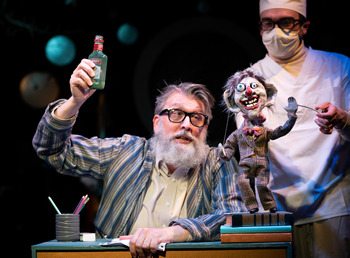
Berryman was born in 1914 and died by suicide in 1972 at age 57. At that time, had been teaching at the University of Minnesota–when not in hospital undergoing rehab for alcoholism and shock therapy for depression. Brosofske's play is constructed as a disordered series of dreams. Berryman is played by Bradley Greenwald with tremendous sensitivity to the psychic ache that was the poet's constant companion. This ache is expressed variously as sorrow, anger, sarcasm, regret, loss, and on rare occasions, hope. The play begins with the police picking up Berryman in a drunken stupor, lying in a snow drift, and taken to a hospital. Along with Berryman, the play prominently features Henry, a figment of Berryman's imagination who appears to us as a puppet. Actor Sam Albright brings Henry to life, transmitting his voice and operating the puppet to endow Henry with a vivid and forceful presence. Henry is the poet's boon companion. He speaks with a wise-guy slur and says what Berryman wants to hear. He encourages his buddy–whom he calls "Berryman," never "John"–to take the low road, cast ambition and self-discipline aside, and, invariably, to have a drink. Berryman knows that Henry is his undoing, but welcomes him anyway. Berryman is also shown in the company of three different women: his third wife, Kate; his obtuse mother; and a nurse representing all of the efficient, no-nonsense nurses with whom he doubtless crossed paths during his assorted hospital stays. All three are performed with exquisite precision by Anna Hashizume. The "Dream Songs" of the play's title refer to Berryman's best-known work. His first published poems appeared in 1940 and his first entire book of poetry in 1942, but he did not achieve instant success. His breakthrough, "Homage to Mistress Bradstreet," was published in 1956 and brought national attention to Berryman, but it was "77 Dream Songs" in 1964 that established him as a leading voice in American poetry, and awarded the Pulitzer Prize in 1965. His 1968 follow-up, "His Toy, His Dream, His Rest," won the National Book Award. Henry appears in both of those works, serving as an alter ego for the poet. In 1969 the two works were published as one volume under the title "The Dream Songs." Like most of Berryman's work, The Dream Songs, draws on his life experience. Many of his memories are tortured as he wrestles with his father's death by suicide when the poet was an adolescent, his remote mother's hasty remarriage, his recurring bouts of depression, and alcoholism. These preoccupations and attempts at recovery, reform, and rejoining the functioning world form the arc of the play's narrative. Brosofske is, foremost, a composer, with a long list of theatre and film underscoring credits, so it is natural that music is integral to Strange Heart. Some passages are sung by either Greenwald or Hashizume. The songs range from moody downbeat tempos to jaunty attempts (by Berryman) to feign high spirits. They bear such evocative titles as "Keep Your Eyes Open When You Kiss," "Whiskey-O," "The Elopement," "Kate's Discovery," "Huffy Henry," "Handkerchief Sandwich," and "A Lament for Delmore." Delmore refers to Berryman's friend, poet Delmore Schwartz, whose death in 1966 triggers a spiral of despair, not only for his lost friend, but for the friable mortality of poets. Aside from discrete songs, underscoring composed by Brosofske is an important element of the production, creating aural equivalent to the emotional state of the characters. The music is splendidly played by a first-rate four-piece ensemble under the direction of keyboardist Jason Frye. By the way, before the play begins, the band plays terrific mid-century jazz numbers as the audience gathers, so come early. Greenwald's performance is a tour-de-force, capturing the unruly blend of Berryman's despair, whimsy, fear, irony, and sheer boredom that keeps him from ever gaining real footing in his life. In moments of affecting command, he ends sentences with heavily emphasized final consonants, as if to give his words more authority. His interactions with Henry are touching, as they are the only moments when he appears relaxed. He is, at times, very funny, such as in his droll critiques of hospital food. At times, he desperately seeks truth from his mother, or summons hope to rebuild a life with Kate. He speaks of their daughter with fondness, yet we discern that, owing to the disruptions in his life, he relates to her as an ideal, not as an actual person. If only he could pull himself together, his child could really exist for him! Greenwald brings all of these needs and feelings to riveting life. Greenwald and Anna Hashizume are both superb singers. Hashizume's opportunities to sing, her vibrant soprano beautifully presenting the thoughts of the wife, mother, and nurse, are high points of the show. As Kate, Berryman's third wife who bore his two children (though the play only mentions one), she fashions a genuine person who loves her husband but is worn down by his repeated descents into drunkenness and depression. As his mother, Hashizume is an aloof placeholder for the attention he should have received as a child, and as the nurse, she demonstrates the tricks of the trade she uses to bring Berryman into submission. Albright is fantastic in bringing Henry to life, creating a full-blown character, both through his voice and in manipulating the puppet's limbs. Albright and Joel Sass, the show's director and set designer, designed Henry, and Karly Gesine Bergmann designed the puppet costumes, all superb work. As director, Sass has knit the different elements of Strange Hearts together to create a coherent collage of meaning and feeling. He draws out the shifts in Berryman's moods so that we can experience lightness, even within a context that we know from the start, will keep him entrapped in darkness. Samantha Haddow's costume for Berryman–rumpled slacks and white shirt beneath an open bathrobe, striped in drab tones of gray, and flailing about with Berryman's movements as if to magnify his disorder–is perfectly conceived. When, in a moment of hope, Kate prepares him to leave the hospital and replaces the robe with a pressed suit jacket, it is as miracles might be possible, a moment that brought a tear to my eye. Costumes for the three women are also quite effective, especially a blue hair covering (something between a hat and a wig) that resembles a large scrubee pad and speaks volumes about Berryman's mother. Bailey Fenn's sound design and Alex Clark's lighting design also contribute to the play's overall impact. There are brief video clips as well, that serve as a connection between Berryman's internal life and the world beyond hospital windows. Strange Heart: The Dream Songs of John Berryman is a beautiful work that evokes tenderness for a man with a gift for poetry whose life was, by all accounts, fraught with turbulence. While the story it presents is unlikely to offer feelings of uplift or hope, there is uplift in the capacity of theatre, with its embrace of text, music, design, and performance, to enable us to experience empathy and to soak up the artistry of these creations. Strange Heart: The Songs of John Berryman runs through March 22, 2026, at Open Eye Theatre, 506 East 24th Street, Minneapolis MN. For tickets and information, please visit openeyetheatre.org. Written and Composed by: Greg Brosofske; Direction and Set Design: Joel Sass; Music Director: Wesley Frye; Costume Design: Samantha Haddow; Lighting Designer: Alex Clark; Sound Design: Bailey Fenn; Puppet Design: Sam Albright and Joel Sass; Puppet Costume Design: Karly Gesine Bergmann; Stage Manager: Janae Lorick. Cast: Sam Albright (Henry/Orderly/others), Anna Hashizume (Kate Berryman/Nurse/Mother), Bradley Greenwald (John Berryman). |