|
Regional Reviews: Minneapolis/St. Paul And Then There Were None Also see Arty's reviews of Beowulf / Feast, Symphony of Rats, Kimberly Akimbo, The Cake, and The Giver
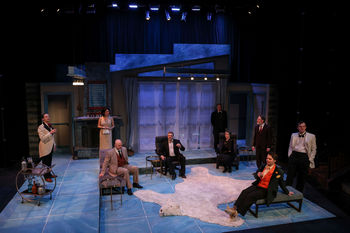
Christie, of course, is the grande dame of the mystery genre. Over an astonishing fifty-five-year career (from 1920-1975), she produced 66 detective novels and 15 short-story collections, to say nothing of her works for stage and radio dramas. Her prose works have sold more than two billion copies, taking third place in total sales after the Bible and the works of Shakespeare. Of that monumental output, Dame Agatha stated that her novel "And Then There Were None" (a note on the title at the end of this review), published in 1939, was her favorite, and also the most difficult for her to write. Her adaptation of the novel into a play was first staged in 1943. Why might And Then There Were None have been the most difficult to write? It veers away from the formula common to most of her works, in which a crime–usually a murder–is committed, a group of suspects identified, and a detective, be they official or amateur, hunts for clues and interviews suspects, leading up to the big reveal. And Then There Were None offers the premise that all of the assembled characters will be murdered (the word "none" in the title is not gratuitous), and there is no detective on the scene assigned to sniff out who is responsible and why this is happening. Dame Agatha set up quite a challenge for herself with this one, but worked it out with remarkable panache. The play is set on a small island off the Devonshire coast of England. Thomas and Ethel Rogers have arrived at the island's sole residence. They are a couple hired by a Mr. and Mrs. Owen as butler and cook, to serve at a gathering of the Owens' associates. One by one those eight guests arrive, each–as is common to the genre–a different type of individual. We have a physician, a retired judge, a secretary, a wealthy bon-vivant, a general, a soldier, an embittered old woman, and a former police officer. A message comes that the Owens are delayed and will not arrive until the next day. Caught off guard by the peculiar circumstance of being a group of strangers gathered without the presence of their host, the guests discover that none of them can remember meeting the Owens. Some were invited as the friend-of-a-friend of the Owens, others don't actually remember the Owens' claim that they had met on a holiday or some such. Even their staff were hired through an agency and have yet to meet their employers. The guests, left on their own, naturally form alliances and antagonisms. And then the murders begin, with only a nursery rhyme framed and hung on the wall and a set of figurines as a guide. I dare not say more about who, how, or why this happens, other than to mention that when adapting her novel into a play, Christie altered the ending, fearing that the level of bleakness with which the novel concludes would not be well received by audiences in the theater. The new ending, actually, feels less of a piece with everything that precedes it than the ending in the novel, but it does allow the audience to leave the theater without a sense of devastation. Director Lee Hanna Conrads works through the intricacies of keeping the plot on track, building the tension as the sky darkens and death toll mounts. A scene enacted by candlelight is especially well played. Conrads knits the differing personalities of the characters together so that their interactions feel fully authentic. In this, the director is aided by a cast that never lets her down. Taking the actors alphabetically, Bruce Abas convincingly portrays the grave moralism and logical mind of Sir Wargrave, the retired judge. David Denninger is persuasive as General Mackenzie, revealing a burden of traumatic memories, Nadya Dominique is sublime as Vera, hired as a secretary quite capable of handling herself under trying circumstances. Davin Grindstaff summons up the anxious energy of that former police officer, Mr. Blore. Emily Jabas happily makes Mrs. Brent a wholly disagreeable character. Michael Quadrozzi, in the role of Fred, who ferries between the island and mainland, is aptly amiable. Drew Reynhout displays the exuberance of Mr. Marston, the bon vivant. Matt Saxe ably conveys Dr. Armstrong's stolid conventionality. Edwin Stout is convincing as the butler Rogers, weary but resigned to his life-long work in service. Brendan Veerman makes a strong impression as the flirtatious and jocular soldier, Mr. Lombard. I missed the chance to see Margaret Reid's performance as Mrs. Rogers, but understudy Sarah Furniss did a wonderful job of playing the role. Without the pre-show announcement, I would never have guessed the role had not been hers all along. Justin Hooper's set design provides the essentials of the English seaside drawing room where the action all occurs. Through a set of glass doors opening to a terrace, we see the view of the churning waters below the bluff on which the house rests. That view is modulated, changing as the sky changes, by Alyssa Kraft's well-conceived lighting design. Brodyn Byington's sound design provides clues as to the plotting by changes in the weather and off-stage events. Zamora S. has designed costumes aptly fitting the period (late 1930s) and each person's station. Now, about the title: The novel originally appeared in print in the U.K. as "Ten Little N...s," the title of an 1869 minstrel song. It was published in the U.S. in 1940 with the title "And Then There Were None," which are the last five words of that song. Between 1964 and 1986, American editions were published as "Ten Little Indians," replacing the British title with a term felt to be more palatable to the public. The original title was used in the U.K. until 1985. However, for her adaptation from book to stage, Christie used the title And Then There Were None from its premiere in 1943. Any fan of Agatha Christie, or more broadly, the mystery genre, will want to head to Lyric Arts in Anoka to see this production. Those who are less smitten by the genre may still find it greatly appealing, owing to its excellent staging, solid performances, and the crackling wit embedded in Christie's work. And Then There Were None runs through March 22, 2026, at Lyric Arts' Main Street Stage Theatre, 420 East Main Street, Anoka MN. For tickets and information, please visit lyricarts.org or call 763-422-1838. Playwright: Agatha Christie; Director: Lee Hannah Conrads; Scenic Design: Justin Hooper; Costume Design: Zamora S.; Lighting Design: Alyssa Kraft; Sound Design: Brodyn Byington; Props Design: Kat Walker; Fight Director: Madeline Achen; Dialect Coach: Gillian C. Rosewell; Stage Manager: Maggie Baukol; Assistant Stage Manager: Kathryn Humnick. Cast: Bruce Abas (Sir Lawrence Wargrave), David Denninger (General Mackenzie), Nadya Dominique (Vera Claythorne), Sarah Furness (understudy), Phoenicia Gamble (understudy), Davin Grindstaff (William Blore), Emily Jabas (Emily Brent), Jeremy Lostetter (understudy), Margaret Reid (Mrs. Rogers), Michael Quadrozzi (Fred Narracott/understudy), Drew Reynhout (Anthony Marston), Matt Saxe (Dr. Armstrong), Tucker Stone (understudy), Edwin Strout (Rogers), Brendan Veerman (Philip Lombard). |