|
Regional Reviews: Minneapolis/St. Paul The Welkin Also see Arty's reviews of Water for Elephants, And Then There Were None, Beowulf / Feast, and Symphony of Rats
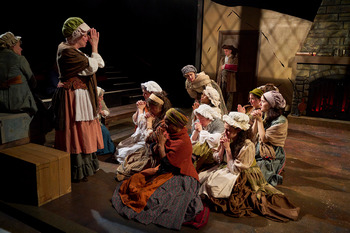
Kirkwood has made Sally an extremely hard woman to root for. In an early scene, Sally, who has left her husband for her lover, returns home to retrieve money and is confronted by her abusive spouse. He is a lout, without question, and no one wants her to bend to his will. Yet her coarse demeanor and ugly reproach make it hard to like her either. But, after all, she has no choice but to fight fire with fire and to be a tigress if she is to prevail against him, so we give her a pass. Let's wait to see her in a better light. But when, among the twelve women chosen to decide her fate, she is just as scornful and nasty to them, it becomes more difficult to sympathize with her. She is aware that all but one of those women have pre-judged her, not only because she has already been found guilty of murder, but because she is an adulteress. They have every reason to doubt her pregnancy claim, for it is a known trick for a woman in her circumstance to "plead the belly." As a twenty-first-century audience, we want to be fair and to hear Sally's case, yet it is hard not to feel pushed away by her unwillingness to make an effort at being agreeable, to allow us to see whatever virtues she may have, or to show an ounce of remorse for the murder for which she was convicted. We want her to win us, along with the jury of matrons, to her side with a geniality she does not possess. Sally's spiteful temperament is also aimed–even more so–at Lizzy, the only one of the twelve women who pleads on Sally's behalf. Lizzy is the local midwife. She brought some of the younger women off the jury into the world, and delivered babies from some of the others. Sally was the first child Lizzy ever delivered, and she alone in the group believes there must be some virtue within her that is worth saving. But Sally wants none of Lizzy's help. Thus, the most wrenching dynamic in The Welkin is between Sally and Lizzy. Their relationship increases in complexity as the play progresses. The other women in the group also play a part in arriving at the play's outcome. They are old and young, well-off and poor. Strong-willed, pious, haughty Emma, is resolved to see Sally hang. She is so bound in religiosity that she calls on the others to pray with her, guiding them to make the right decision–namely, her own. Charlotte is a stranger, a proper upper-class woman there on a visit, who was recruited to the cause, and turns out to have dark ulterior motives. The mute Sarah Hollis has not spoken for twenty years, yet knows things about this case unknown to the others. Sarah Smith speaks with wisdom as the elder of the group, having borne 21 children by three husbands, and still on her feet. Mary is a simple-minded soul, eager to make the decision and get back to her chores, while Helen appears to be sympathetic toward Sally's plight until submerged grief and anger flare up and alter her position. Judith is totally distracted by a plague of hot flashes, which is the cause of the windows repeatedly being opened and allowing the taunts of the angry mob to be heard by those within the chamber. In this universe of women, the men still have control. The jurors are introduced and sworn in by the unseen voice of the magistrate (Jim Ramlet, recorded), in sonorous bass tones that confer the court's authority upon them. A doctor makes himself available to examine Sally after the women's prayer, and Sally's efforts at lactation prove useless. Mr. Coombes–the bailiff assigned to passively guard the women during their deliberation–ends up wielding shocking power, even absent the court's authority. All of the actors create vivid portraits of these and other characters. Elizabeth Efteland gives an astonishing performance as Sally, whose life has been a series of torments and, for the sake of a brief grasp of pleasure and joy, now falls prey to the ultimate torment. While we have difficulty liking Sally, Efteland's portrayal enables us to understand her and, at last, earn our mercy. Tracey Maloney endows Lizzy with the might of reason and a strident resolve that women must seize collective power over their lives–an idea as foreign to these women in 1759 as television. In addition to Lizzy's strength, Maloney shows her struggle to uphold her positions against undercurrents that spring forth from her past, much as social media casts shadows, rightly and wrongly, upon the integrity of our public figures. Among the other actors, Georgia Doolittle as Emma, Charla Marie Bailey as Sarah Hollis, Wini Froelich as Helen, and Kathleen Winters as Charlotte give especially strong performances. Eva Gemlo's Peg, Kirby Bennet's Judith and Suzie Juul's Mary are also noteworthy, with Juul having the opportunity to shine in lifting up a song in a moment that confers solace on the women. Patrick Bailey gives a strong showing as Mr. Coombes, the bailiff who quietly seethes with resentment at the women, and Jonathan Feld is convincing both as the cuckolded Frederick Poppy and genteel Dr. Willis. Director Wendy Knox maintains authenticity in the narrative, shining light on these women's frank knowledge of one another, the swirl of interactions among them, and the conflicting terms of the charge to them. The court has empowered them with a life-or-death decision, but their ken remains bound by the routines baked into their lives, illustrated by framing pantomime images that begin and end the play. The hours spent deciding Sally Poppy's fate are a brief respite–and for most, an uncomfortable one–from the narrow scope of their lives. Perhaps there is a flicker of hope to broaden that narrow scope, hope arriving in the sky above. Worked into The Welkin is anticipation of seeing Halley's Comet, which the English astronomer Edmond Halley correctly predicted would return past the Earth between 72 and 79 years after its 1682 appearance. There are documented sightings of the comet as far back as 240 B.C (seen in China), but it was Halley who calculated the duration of its cycle, allowing us to predict its return. It was visible on Earth in both 1758 and 1759, the year in which the play is set, and the first opportunity for Halley's prediction to be tested, validating the faith placed in the scientist's cosmology. The women in The Welkin are fascinated by the impending arrival of he comet and that something so dazzling and powerful could behave with such regularity. I found myself wondering if the women find in the regularity of the comet's orbit a kinship to the regularity of their bodies' cycles, lifting up those monthly events to the realm of wonderment, asserting the majesty conferred by their life-nurturing power, though they dare not claim it. Joe Stanley's scenic design is an aptly bleak space. It is not a well-appointed court room, but a chamber only a notch above a cell that would hold the prisoner, its high-placed windows limiting the entry of light. Tony Stoeri's lighting shifts to evoke variations within the darkness of this chamber, altering the moods of the piece. Dan Dukich's sound design and composition convey the grit of life in this world, and the tensions among the characters. Kathy Kohl's costumes wonderfully convey the mid eighteenth-century rural English period and the distinctions among the women's social status. The accents, with Patrick Bailey as dialect coach, bear the sound of authenticity and are consistently employed. On that score, kudos to all. However, owing to their thickness, from time to time it is difficult to make out some lines, which is a shame, since every line is of value. The Welkin is a muscular play, with a large group of interesting and believable characters, well-crafted dialogue, and an engrossing narrative. Wendy Knox, the entire creative team, and the praise-worthy cast deliver an incendiary production of a challenging and provocative work. The beast has been conquered but, thankfully, not subdued. The Welkin runs through March 29, 2026, at Gremlin Theatre, 550 Vandalia St., St. Paul MN. For tickets and information, please visit franktheatre.org or call 612-729-3760. Playwright: Lucy Kirkwood Director: Wendy Knox ; Set Design: Joe Stanley; Costume Design: Kathy Kohl; Lighting Design: Tony Stoeri; Sound Design and Composition: Dan Dukich; Props Design: Sarah Harris; Dialect Coach: Patrick Bailey; Stage Manager: John Novak. Cast: Charla Marie Bailey (Sarah Hollis), Patrick Bailey (Mr. Coombes), Kirby Bennett (Judith Brewer), Willa Buchanan (Katy Luke/ Alice Wax), Isa Condo-Olvera (Kitty Givens), Georgia Doolittle (Emma Jenkins), Elizabeth Efteland (Sally Poppy), Jonathan Feld (Fred Poppy/Dr. Willis), Dona Werner Freeman (Sarah Smith), Wini Froelich (Helen Ludlow), Eva Gemlo (Peg Carter), Grace Hillmyer (Hannah Rustad), Jiccarra N. Hollman (Ann Lavender), Suzie Juul (Mary Middleton), Tracey Maloney (Elizabeth Luke), Jim Ramlet (Voice of the Magistrate), Kathleen Winters (Charlotte Cary). |