|
Regional Reviews: Minneapolis/St. Paul Waking Miss Daisy Also see Arty's reviews of Strange Heart: The Songs of John Berryman and The Welkin
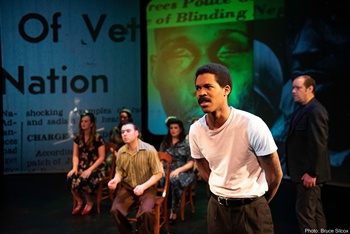
In 1990 I saw the film version, the one that won the Oscar for Best Picture, for Jessica Tandy, and for Uhry for his adaptation. It was the same story, and I had the same reaction. The fact that I am, like Daisy, white and Jewish didn't enter my thinking. Did it? In any event, I had not seen the play or the film again since, nor given it much thought. Springboard to 2026, almost forty years since the play's Off-Broadway opening in 1987, and things look a bit different. We now see things through the lens of Black Lives Matter, Barack Obama, white fragility, wokeness, and, at present, a war against wokeness. This draws a sharper focus on the relationship between Daisy and Hoke, as well as Boolie, Daisy's businessman son who hires Hoke to drive his mother after she, at the age of 72, crashes her car into the neighbor's yard. Daisy stubbornly refuses to let Hoke drive her anywhere, more because her pride is hurt than because of race prejudice, though there is a trace of the latter as well. Over the course of twenty-five years, Daisy relents, she comes to appreciate Hoke, and they form a bona fide friendship. At least, we hear Daisy say to Hoke, "You're my best friend." But I forget, what does Hoke say? That's where veteran Twin Cities-based actor James Craven enters. Craven, a Penumbra Theatre company member since 1981 who, within an impressive body of work, played Hoke in a 2012 production of Driving Miss Daisy at Jungle Theater in Minneapolis, winning an Ivey Award (along with the other two actors in the play) for his performance. He asked the director of that production, "How did Daisy feel about all the racial violence and segregation going on in Atlanta?," to which the director replied, "She didn't know." In 2023, Craven approached Kym Longhi, the artistic director of Combustible Company, with the idea of a play that continues that conversation, starting with the follow-up question, "Why didn't she know?" Waking Miss Daisy is the result of Craven's initiative, and it is now receiving its premiere in the intimate Frey Theater at St. Catherine University in St. Paul. Craven and Longhi collaborated as playwrights, and Longhi directed the production. Waking Miss Daisy runs just 80 minutes (without intermission) and does not make any attempt to capsulize the entirety of Uhry's play. It does use snippets from the play in rehearsal, as the actor playing the role of Hoke engages in a running dialogue with the playwright (not named Uhry, but a fictionalized rendering) raising such questions as "why didn't she know?." It begins as the Actor (Dominique Drake) auditions for the role, and he is not satisfied to passively accept the Hoke as written, but challenges the Playwright (Nick Miller) to make the character as full and important as Miss Daisy, with his own history, needs, and a life beyond his job. He wants to understand Hoke as more than a catalyst for Daisy's enlightenment, but as a full person, raised and living in a context far apart from Daisy's affluence and subject to the indignities of Jim Crow. As the play goes into rehearsal and the Actor assumes the guise of Hoke, playing scenes with Daisy (Barbara Berlovitz) and Boolie (Erik Hoover), we slide back and forth between those snippets and the Actor and Playwright debating why information about Hoke's life, and Black life in Atlanta, is omitted from the story. The script presents these two tiers very well, with smooth transitions between them. It does allow the Actor, as he embellishes on Hoke's part, to take the upper hand, as the Playwright tries to restrain him ("That is not the play I wrote!") but often finds that the Actor's arguments are sound. We, the audience as well as the actors, do need to know more. There can be more balance in the play, rather than allowing "She didn't know" to be good enough response. Combustible Company is very attentive to the physicality of performance. The principal actors and an eight-member ensemble change the settings by moving furnishings and props on and off stage, but not as one might carry a chair, held safely in front of the body. Rather, they carry each item with sweeping motions, essentially dancing, making transitions a space to adjust to the narrative shift, and through their movements, set the tone for the scene to come. This is especially effective in setting a scene that depicts the bombing of the Werthan family's synagogue (a true event), evoking the shock and mayhem of that incident. Dominique Drake is top-flight in the Actor/Hoke role, persuasive as the Actor making his case for full representation without becoming bellicose, and as Hoke, amiable, while finding ways to fill in the gaps the playwright has left in his profile. Nick Miller is excellent as the Playwright, defensive about his work and pushing back on the charge that he has a responsibility to go beyond the parts of the story that are within his comfort zone. Barbara Berlovitz is prickly, witty, and regal as Daisy, gradually removing the blinders that have kept her from seeing that racism is as real and as invidious as antisemitism. Erik Hoover is effective as Boolie, a smaller role that allows him to also be part of the ensemble. The ensemble is well integrated into the flow of the narrative. In a particularly well-conceived scene, three ensemble actors portray members of the Daughters of the Confederacy, who have invited Daisy to their meeting. Daisy is pleased to be considered for membership in that elite group, but is immediately disabused of the pleasure when she enters and finds the three pretentious ladies seated on comfortable chairs, and have left only a child-sized chair for her to squat down on. The set is nothing more than five floor-to-ceiling screens that form an arc across the stage. These are used to project video footage (designed by Jim Peitzman) of elegant Southern trees dripping with moss, neighborhoods of Atlanta, civil rights rallies and protests, lynchings, the torching of a synagogue, and anything else deemed necessary for us to see. Jacqulin Stauder's lighting design is an essential complement to these projections, as well as to the choreographed transitions. Joni Griffith contributes effective music and sound, including playing fiddle through portions of the play, semi-visible through one of the screens. The focus of Waking Miss Daisy is not on telling a variation of the same story Uhry's play did in 1987, but on raising questions about how we tell stories, especially stories that purport to show how we lived in the past or live in the present. How do we ensure that the stories are balanced? Why do we allow characters to make unchallenged claims or to accept that things are "the way things are?" When evil is depicted, why do we allow "these things sometimes happen" to be a sufficient response, without asking, "why do they happen?" In Waking Miss Daisy Combustible Company has devised and produced an important play, presented with artistic flair and intellectual integrity. It is a shame that its run is so short, but let's hope the resources can be marshalled for a return engagement, along with runs beyond Minnesota. Waking Miss Daisy, a Combustible Company production, runs through March 15, 2026 at the Frey Theater at St. Catherine University, 2004 Randolph Avenue, St. Paul MN. For tickets and additional information, please visit www.combustiblecompany.org. Playwrights: James Craven and Kym Longhi, conceived by James Craven; Director: Kym Longhi; Costume Design: Matthew Wilhelm; Lighting Design: Jacqulin Stauder; Music and Sound: Joni Griffith; Video Design: Jim Peitzman; Stage Manager: Matthew Wilhelm; Producer: Kym Longhi. Cast: Barbara Berlovitz (Miss Daisy), Michael DiPrima (ensemble), Ariel Donahue (ensemble), Dominique Drake (Hoke/The Actor Playing Hoke), Joni Griffith (ensemble), Renee Howard Hatton (ensemble), Erik Hoover (Boolie/ensemble), Lily Jones (ensemble), Nick Miller (The Playwright), Anna Pladson (ensemble), Ben Qualley (ensemble). |