|
Regional Reviews: Minneapolis/St. Paul A Trojan Woman Also see Deanne's review of Battle of the Improv All-Stars 2026 and Arty's review of Joe Turner's Come and Gone
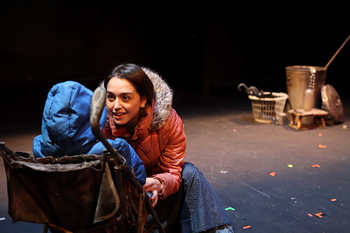
Playwright Sarah Farrington's modern adaptation, called A Trojan Woman, was first staged under the auspices of the Interbalkan Festival of Ancient Drama on a mountain in Greece, near to where Euripides' play was first presented in 2023. Since then, it has played in Belfast, London, and New York. It has now embarked on a "Sanctuary City Tour," making its first stop at Mixed Blood Theatre in Minneapolis, which concluded on June 7. It will go on to San Francisco and Washington D.C. before returning to New York. Farrington's title is significant, changing the plural "women" to the singular "woman." The play opens with one woman, unnamed and simply referred to as "The Civilian," her torso engulfed in a puffy pink winter parka as she frantically pushes a stroller in which rests a child, represented by a puffy blue snow suit. Circling madly, the civilian repeats over and over, mantra-like, "They don't kill civilians," as she tries desperately to reach a safe place. The scene resembles so many images broadcast in news footage over the years, from besieged cities around the world. The mother's terrified state belies the hopeful manta "they don't kill civilians"; we strongly suspect that she already knows better. A blast and a flash of light bring this woman to the wreckage of Troy, following its sacking at the hands of the Greeks, the victors of the Trojan War thanks to the deception led by Odysseus, who hid along with a legion of the mightiest soldiers within a large wooden horse. The Greeks are destroying the city, slaughtering men, portioning out women as rewards for the victorious warriors, and the children orphaned. The Civilian now finds herself in this inferno, where she takes the form of the women, and some of the men, who played integral parts in the proceedings. The Citizen and other characters are played by one of two actors, who alternate in performances of the demanding play. India Shea, the actor at the performance I attended, was stunning, becoming a new character with a change in her voice and the use of the most ordinary of objects. The first war victim we meet is Hecuba, the dethroned queen of Troy who was married to the Trojan king Priam (killed in battle), and is mother of Cassandra (a priestess brutally raped by the Greek warrior Ajax the Lesser), of Hector (an esteemed warrior killed by Achilles) and Paris, who triggered the Trojan War when Helen, wife of the Spartan king Menelaus, left Sparta for Troy to become Paris's wife. Whether Helen was abducted by Paris or left with him willingly is open to debate. Hecuba has ample reason to despair; on top of this, she is imprisoned to become a concubine for Odysseus. The Civilian portrayed Hecuba by placing a plastic-latticed laundry basket over her head, creating the illusion of humiliation behind prison bars. She more than wailed, she keened–with The Civilian giving us a demonstration of the sound of a woman keening, a sound that demands attention by grabbing the listener's heart and squeezing it dry. Hecuba becomes the moderator who introduces us to some of the other characters, including her daughter-in-law Andromache, widow of the slain Hector whose first-born son, Astyanax, though still a child, is killed by the Greeks lest he grow to seek vengeance for his father's death. Hecuba connects us with her debased daughter Cassandra, the Greek envoy Talthybius who casts himself as a neutral party ("just the messenger"), and Menelaus, whose martial humiliation started the war. Helen comes forth, using a long string of shiny beads to convey the duplicitous nature of a cunning vixen as she defends herself as a hapless victim, while Hecuba denounces her as a harlot who brought on this world of misery (overlooking her son Paris's role in the matter). We also observe Athena, goddess of the hunt, prevailing upon Poseidon, god of the sea, to inflict punishment on the Greeks for encouraging the rape of Cassandra. Hecuba accuses the gods of being falseness: instead of punishing those who defiled Cassandra, couldn't they have prevented that defilement in the first place? With the aid of a signature prop, all of them common objects, the Civilian transformed into each personage in this woeful business. India Shea kept the audience enthralled as she seamlessly shifted from one distinctive voice to another. Among those was the voice of the chorus, represented by two umbrellas that the actor pointed toward the audience, opening and closing their maws, one in each hand, in a manner that suggested an unenlightened public passing judgement and mindless rumormongering. One suspects that director Meghan Finn has worked closely with the playwright in devising a presentation of Euripides ancient work that balances abstraction with directness to convey its message to contemporary audiences. Christopher Swader and Justin Swader's scenic design, a backdrop that suggested a battle-scarred firmament, created a brutal landscape for the play. Brian Aldrous's lighting design accentuated the terrors and uncertainties of violent conflict, while Mike Cassedy's composition and sound design provided an aural counterpart to that strife. Designer Claudia Brown's costume ingeniously transformed a 21st century refugee into the realm of antiquity, underscoring the unceasing presence of war throughout human history. The overall effect was a panorama of senseless misery and destruction wrought by war. The prizes are one's honor, boasting rights, a concubine who despises you, the power to turn a society to ashes. There are no higher callings served, no essential unmet needs that require a kingdom to go to battle, no threat to a nation's security or well-being. Euripides must have been a man of great courage to call out the folly and the tragedy of warfare in a society that was primed to militancy. Sadly, it seems that his work was unable to deter the bloodshed of the Peloponnesian war–though I wasn't there, and perhaps the play had some moderating effect that kept things from being worse. Hard to imagine, isn't it? Yet we continue to hope for music, theatre, and other artistic expressions to act as deterrents against the insanity of people rising violently against other people. With The Trojan Women, Euripides aimed to show the effect of war on the women left in its aftermath. In A Trojan Woman, Farrington and her creative team take this same message and funnel it into the core of a single woman, who could be any woman, or any human being, really. It communicates, both poetically and tersely, an awareness that when any one of us could be the victim, all of us are the victims. A Trojan Woman, a presentation by Stop the Wind Theatricals, played June 3, 2026 - June 7, 2026, at Mixed Blood Theatre, 1501 S. Fourth Street, Minneapolis MN. For information about Mixed Blood, please visit mixedblood.com. Playwright: Sara Farrington; Director: Meghan Finn; Scenic Design: Christopher Swader and Justin Swader; Costume Design: Claudia Brown; Lighting Design: Brian Aldrous; Composition and Sound Design: Mike Cassedy; Technical Director: Lucas Martin; Production Coordinator and Stage Manager: Claire Aiderfer; Producer: Carol Ostrow. Cast: Madelyn Robinson *(Civilian - June 3, 5, 7); India Shea *(Civilian - June 4, 6). *Alternating performances. |