|
Regional Reviews: Minneapolis/St. Paul Perfect Arrangement Also see Arty's reviews of Spamalot, My Ántonia and A Trojan Woman and Deanne's review of Battle of the Improv All-Stars 2026
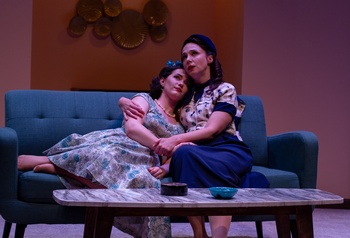
That gave me plenty of chances to observe the apartment occupied by Lucy and Ricky Ricardo. The furniture was oddly arranged in that none of its seating allowed people to face one another, but rather, all faced the fourth wall from which the audience was watching. This worked for a sitcom filmed before a live audience but doesn't work for real life. In Topher Payne's notes accompanying the script to his play Perfect Arrangement, he recommends that a production try to recreate the feel of an early 1950s sitcom by designing its single living room set to closely replicate the famous Ricardo living room. Like the Ricardos' home, it is arranged so that residents Bob and Millie Martindale and their next-door neighbors/best friends, Norma and Jim Baxter, could sit facing the audience rather than each other. Again, not an ideal arrangement for real people, but perfect for simplifying the staging of a performance. The play's title, though, means something different by "perfect arrangement." It refers to the arrangement among the four spouses occupying the two apartments, who are all homosexuals. It is 1950 and Bob and Norma both work for the U.S. State Department (Norma is Bob's secretary, of course). To allay suspicions about their personal lives, they each married the other's partner and set up sham housekeeping in next-door apartments. A walk-through secretly cut between closets in each unit allows them to enter their front doors as heterosexual couples and sort themselves out into gay couples by bedtime. A perfect arrangement, yes? Walking Shadow's current staging of Perfect Arrangement at the Crane Theatre presents a near-perfect duplication of Lucy and Ricky's apartment. The production worked so hard as a team to mirror the original (a process described in the program notes) that no credit is given for a scenic designer, though Alice Endo is credited as "scenic drafter." The setting indeed brings '50s sitcoms to mind, along with their supposition that families came only in uniform configurations, starting with one man and one woman. Bob and Norma's office at the State Department is involved in ferreting out communist sympathizers under pressure from Senator Joe McCarthy and the Red Scare that attended the dawn of the Cold War after World War II. The play opens with a social gathering in the Martindales' living room. Joining Bob, Millie, Jim, and Norma is another couple, Ted and Kitty Sunderson. Ted is Bob's boss. Over small talk and toothless jokes, Kitty shows herself to be an endearing ditz, and Ted a boor who refers to their wives as "the hens." The banter comes to a halt when Ted announces that the reason he wanted to gather was to inform Bob that his role at the Department is being expanded. Henceforth, they will not only pursue Communists, but other degenerates who are security risks because they are subject to blackmail. Asked to elaborate, Ted lists drunkards, loose women, and, being delicate in the presence of ladies, "men who prefer the company of other men, to which Kitty blurts out, "You don't mean fags, do you?" Every sitcom episode revolves around a crisis that, by way of wacky shenanigans or clever plotting, is resolved before the final credits roll. Bob, Jim, Millie, and Norma seem at first determined to do just that, but reality is not a sitcom, and things begin to get dicey, even as the laughs continue. Bob has no qualms about dismissing suspected gay and lesbian employees while he lives a lie, but seeing her co-workers drummed out the door takes a toll on Norma. Matters become especially tense when an old female flame from Milly's college days surfaces, threatening to expose the "perfect arrangement." Should they try to protect their deception? When Norma suggests that it might be best to end the ruse, Milly tells her that she loves their life, and that every couple is entitled to a "private life," to which Norma retorts "private, yes, not secret." With smart and authentic dialogue like this, Payne shifts gears in the second act from a mirthful farce circling around an issue to a serious drama relieved by dark humor. The play continues to dish out uproarious comic bits, such as Milly trying to conceal her face from her old flame with comic flare worthy of Lucy herself. But there are also serious conversations about the risks they face. Jim, who is a teacher, knows he will never work again if he is outed. There is regret and anger, by some, of the harm they are doing by enabling what came to be called the Lavander Scare. In these exchanges are the seeds of a nascent gay rights movement that would take 65 years to achieve the right to marry–a right now being threatened anew. John Heimbuch's direction keeps the production in step with that shifting tenor from farce to drama without ever a moment that feels like an abrupt swing. The laughs are hearty; the serious business is heartfelt and searing. Along with the fabulous set, Mandi Johnson's costumes perfectly capture the zeitgeist of the era, as well as the temperament of each character. Thomas Speltz composed music to bridge the scenes that harken to the high-energy theme songs of those old sitcoms, masking a strain of dissonance that hints at trouble beneath the gleaming 1950s veneer. The cast are all aces. Joe Swanson exudes Bob's confidence in being able to sail above the storm, believing that his reputation in the Department will spare him the pain he is inflicting on others. Theo Janke-Furman conveys Jim's fears that his situation is more tenuous but also conveys genuine devotion to Joe that keeps him on board. Elora Riley, as Millie, comes closest to channeling Lucy with sitcom vibes, but also delivers her character's serious side with conviction. Rachel Postle gives an equally impressive performance as Norma, who, more than any of the others, expresses anger about the dire situation they are in merely because of who they love. She also reveals vulnerability about the one unattainable thing she dreams of: a baby. Both couples have palpable chemistry that makes their relationships and efforts to protect them believable. Julie Ann Nevill is delightful as ditzy Kitty, desperate to befriend the wives she has met on outings to her manicurist, a new hat shop, and the opera. Nevill masterfully delivers laugh lines without betraying her character's naivete. She does offer one brilliant observation, about the power of the phrase "sometimes things just don't work out." Peter Colburn is excellent as the bully, chauvinistic boss who forces the issues in Bob's office. Lily Rains is terrific as Barbara Grant, the interloper whose appearance turns the story on its head. She exudes calm sophistication and looks swell in the chic apparel Maddi Johnson has designed for her. My one wish is that she had spoken louder–her hushed tone expresses her unflappable character but also makes her difficult to hear. Perfect Arrangement premiered in Washington D.C. (in the shadow of the State Department that inflected so much pain during the Lavender Scare) in 2013, a time when state after state was approving same-sex marriage or, short of that, strengthening laws permitting civil unions. In two more years, the Supreme Court ruling in Obergefell v. Hodges would make same sex marriage legal in all fifty states. Perfect Arrangement went on to play at regional theatre comapnies around the country from Anchorage to Atlanta in 2014 and had an Off-Broadway at Primary Stages in 2015. If the mood around its early productions was one of celebratory progress that placed the debacle depicted in Perfect Arrangement in the rearview mirror, today it serves as a cautionary tale, not only about how dire things once were, but also about how much might be lost with movements afoot to revoke a raft of human rights, including the right to marry without regard to gender. That makes it a timely as well as a vastly entertaining play. This is what theatre excellence looks like. Perfect Arrangement, a Walking Shadow Theatre Company production, runs through June 21, 2026, at the Crane Theatre, 2303 Kennedy St. NE, Minneapolis MN. For tickets and information, please visit www.workingshadow.org. Playwright: Topher Payne; Director: John Heimbuch; Scenery Drafter: Alice Endo; Costume Designer: Mandi Johnson; Co-Lighting Designers: Aarya Batchu and Tony Stoeri; Composer and Sound Designer: Thomas Speltz; Props Designer: Sarah Harris; Intimacy Director: Alli St. John; Stage Violence Coordinator: Sophina Saggau; Vocal Consultant: Keely Wolter, Stage Manager: André Johnson Jr.; Production Manager: David Pisa. Cast: Peter Colborn (Ted Sunderson), Theo Janke-Furman (Jim Baxter), Juliee Ann Nevill (Kitty Sunderson), Rachel Postle (Norma Baxter), Lily Rains (Barbara Grant), Elora Riley (Millie Martindale), Joe Swanson (Bob Martindale). |