|
Regional Reviews: Minneapolis/St. Paul Home, I'm Darling Also see Arty's reviews of Spamalot, Perfect Arrangement, My Ántonia and A Trojan Woman and Deanne's review of Battle of the Improv All-Stars 2026
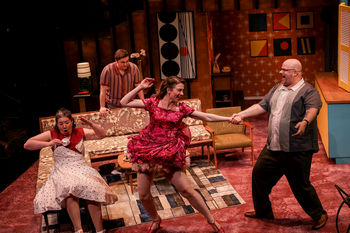
I also had a father who came home from work in the evening and a mother who (at that point in time) was at home all day and had prepared supper for him, me, and my siblings. But my dad didn't call out, "Claire, I'm home." Nor did my mother greet him like those TV wives, in a fashionable dress suitable for a ladies' luncheon and a string of pearls. And my dad did not always come home for a family dinner, as he often had to work late or else got stuck on a slow commuter train or expressway traffic. Reality did not always match the model of 1950s life as contrived by mass media and the advertisers that supported it in the U.S. and apparently also in England, going by Laura Wade's devilishly smart comedy, Home, I'm Darling. The play is set in a middle-class London suburb, but not in the 1950s, though the central characters, a married couple named Judy (Kendra Mueller) and Johnny (Kyler Chase), behave as if it is. Rather, the year can be taken to be 2018, when Home, I'm Darling premiered at a British regional theater, followed by a production in London's West End that won the 2019 Olivier Award for Best Comedy. Home, I'm Darling is being presented by Lyric Arts in a production that draws out both the sharp wit and the troubling undertones beneath the surface of Judy and Johnny's marriage. The pair met over a mutual love of 1950s style and design. Three years earlier, the couple's enjoyment of their mid-century modern home and furnishings (a terrific two-level set designed by Greg Vanselow) and vintage 1950s garb (Sarah Christenson is the wiz who designed these, matching each of Judy's numerous dresses with a necklace and pair of heels) was disrupted when Judy's job in finance fell victim to budget cuts. Rather than seek other employment, she poses a radical notion: instead of just surrounding themselves with reflections of the fifties, why not actually live like people did back then? She would stay home full time, filling her days with cleaning, cooking, baking, and sewing. Every morning, she'd prepare Johnny's lunch, packed in a lunchbox for him to take to the office, and be there with his slippers, a cocktail, and dinner on the table when he comes home. Johnny protested that this seems a little sexist, but Judy persuaded him that it isn't, because this was her choice–and just think how nice it would be for him. Fast forward three years, and they are still at it, but beneath the surface trouble is brewing. Johnny's sales numbers are down and he's under pressure to be named for a promotion at work. Judy's attempt to help by inviting Johnny's new boss (Izzy Maxwell) to dinner doesn't go as planned. Issues with their friends Fran and Marcus (Siri Hellerman and Charles Morgan) further complicate the equilibrium. And Judy's feminist mother, Sylvia (a fabulous Patti Hynes-McCarthy), is appalled to see her daughter throw away opportunities denied to her, for which fought and protested so her daughter would not face the same barriers. What seems at first like kooky but harmless cosplay starts to reveal an unsettling schism between Judy and John, but Judy can't bring herself to quit, claiming that without the fifties, she doesn't know who she is. The play begins with a series of jokey banter, along the lines of the sitcoms Judy and Johnny's lives have been aping. These are sometimes exaggerated, as when Judy looks closely at each breakfast item–eggs perched in egg cups, toast and jam, coffee cups–granting each an approving smile before placing it on the table, giving a sense that living in the '50s is not the natural state of things, but something Judy works on. She performs these actions willingly, even desperately, but not naturally. Scott Ford's direction allows for these mannerisms, assuring that we are always aware that what is going on in Judy and Johnny's home is not something that organically developed, but that was deliberately chosen. You can, after all, live "like people did in the 1950s", but the operative word is "like." This is not real life, but a charade satisfying some other need. This comes out full force when Sylvia, finally unable to tolerate what she sees, goes on a tirade, marvelously delivered by Hynes-McCarthy. She points out that she actually lived through the fifties and that they were horrible, itemizing the reasons why–food rations, energy shortages, misogyny, racism, homophobia–in livid detail. The production is greatly elevated by Mueller's indelible performance as Judy, showing us the pains Judy goes to to make her enactment of the 1950s façade seem effortless, expertly delivering a proper housewifely giggle between sentences, but launching into heavy truth-telling when she and Johnny finally lay down their hands. Chase is ideally matched to her as Johnny, with an affable boyish face that projects a docile acceptance of the way Judy has arranged their lives and an authenticity when he challenges her to be committed to one another, and not to the charade that has consumed their lives. As already noted, Hynes McCarthy's spot-on performance as Sylvia is quite special. Maxwell as Alex, as Fran, and Morgan, as Marcus, all deliver solid performances, with Morgan especially effective at creating a sense of ambiguity over whether or not some of the "fixes" for workplace sexism have gone too far. All of the actors do well delivering their lines with British accents, with a shout-out to dialect coach Gillian C. Rosewell. Choreographer James Grace had an unusual assignment in this production. The scene changes are executed in full view of the audience, with members of the cast moving furniture or rearranging props in a choreographed manner–sometimes breaking out into a brief bit of actual '50s-style dance. There is a scene in which Judy is insistent on dancing with Marcus (after all agree that Johnny is no dancer) when the two couples are having a dinner together, that gets surprisingly wild, revealing the ire pent beneath Judy's staunchly proper '50s veneer. One thing that baffles me about Home, I'm Darling is that neither of the two couples depicted have children, nor do they appear to want to have children–at least not at this moment in their married lives. The logic of being a wife who stays home while the husband went to work had at least as much–probably more–to do with caring for their children. In that era, when one middle-class salary could support a family and child-care had not become an "industry," it made sense for one parent to take on that role. In reality, many young wives in the 1950s did work, until their first pregnancy. At one point, Judy states that she always wanted a mother like that to come home to, but her choice is not about providing a warm, safe harbor for one's young children, which deflates her argument considerably. Of course, the fact that it was practically always the mother, not the father, who cared for the children and volunteered at their schools, well that's gender-role bias, absolutely. But that's not the issue here. Home, I'm Darling caught me by surprise. I expected an amusing but inconsequential British comedy and was treated to a play that is, indeed, very funny, but as the wheels turn, becomes increasing serious and provocative. Moreover, everything about Lyric Arts' staging of the play is top notch. It is well worth the trip to Lyric Art's Main Street Stage theater in Anoka to catch this play. Home, I'm Darling runs through June 21, 2026, at Lyric Arts' Main Street Stage Theatre, 420 East Main Street, Anoka MN. For tickets and information, please visit lyricarts.org or call 763-422-1838. Playwright: Laura Wade; Director: Scott Ford; Choreography and Intimacy: James Grace; Scenic Design: Greg Vanselow; Costume Design: Sara Christenson; Lighting Design: Lucas Granholm; Sound Design: Laura Felde; Props Design: Ren Edson; Composer/Music Consultant: Jason Paulson; Dialect Coach: Gillian C. Rosewell; Stage Manager: Emerson Stenbeck; Assistant Stage Manager: Kathryn Humnick. Cast: Kyler Chase (Johnny), Siri Hellerman (Fran), Patti Hynes-McCarthy (Sylvia), Izzy Maxwell (Alex), Charles Morgan (Marcus), Kendra Mueller (Judy). |